Desiderius, 1469-1536 Erasmus
![A dialoge or communication of two persons
Deuysyd and set forthe in the late[n] tonge, by the noble and famose clarke. Desiderius Erasmus intituled [the] pylgremage of pure deuotyon. Newly tra[n]slatyd into Englishe.](https://cdn.readfeed.com/book_covers/fullsize/gutenberg-14746.jpg) A dialoge or communication of two persons
Deuysyd and set forthe in the late[n] tonge, by the noble and famose clarke. Desiderius Erasmus intituled [the] pylgremage of pure deuotyon. Newly tra[n]slatyd into Englishe.
A dialoge or communication of two persons
Deuysyd and set forthe in the late[n] tonge, by the noble and famose clarke. Desiderius Erasmus intituled [the] pylgremage of pure deuotyon. Newly tra[n]slatyd into Englishe.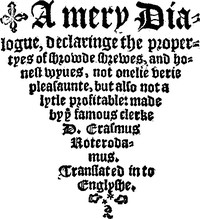 A Merry Dialogue Declaringe the Properties of Shrowde Shrews and Honest Wives
 A Modest Meane to Mariage
pleasauntly set foorth by that famous Clarke Erasmus Roterodamus, and translated into Englishe by N.L.
A Modest Meane to Mariage
pleasauntly set foorth by that famous Clarke Erasmus Roterodamus, and translated into Englishe by N.L. A Very Pleasaunt & Fruitful Diologe Called the Epicure
 Erasmus Against War
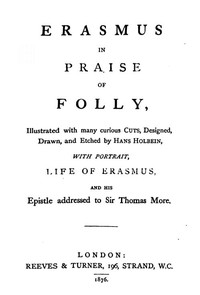 In Praise of Folly
Illustrated with Many Curious Cuts
In Praise of Folly
Illustrated with Many Curious Cuts One dialogue, or Colloquye of Erasmus (entituled Diuersoria)
Translated oute of Latten into Englyshe: And Imprinted, to the ende that the Judgement of the Learned maye be hadde before the Translator procede in the reste.
One dialogue, or Colloquye of Erasmus (entituled Diuersoria)
Translated oute of Latten into Englyshe: And Imprinted, to the ende that the Judgement of the Learned maye be hadde before the Translator procede in the reste. Selections from Erasmus: Principally from his Epistles
 The Colloquies of Erasmus, Volume I.
 The Education of Children
 The Praise of Folly
![Two Dyaloges (c. 1549)
Wrytten in laten by the famous clerke, D. Erasm[us] of Roterodame, one called Polyphemus or the gospeller, the other dysposyng of thynges and names, translated in to Englyshe by Edmonde Becke.](https://cdn.readfeed.com/book_covers/fullsize/gutenberg-14500.jpg) Two Dyaloges (c. 1549)
Wrytten in laten by the famous clerke, D. Erasm[us] of Roterodame, one called Polyphemus or the gospeller, the other dysposyng of thynges and names, translated in to Englyshe by Edmonde Becke.
Two Dyaloges (c. 1549)
Wrytten in laten by the famous clerke, D. Erasm[us] of Roterodame, one called Polyphemus or the gospeller, the other dysposyng of thynges and names, translated in to Englyshe by Edmonde Becke.