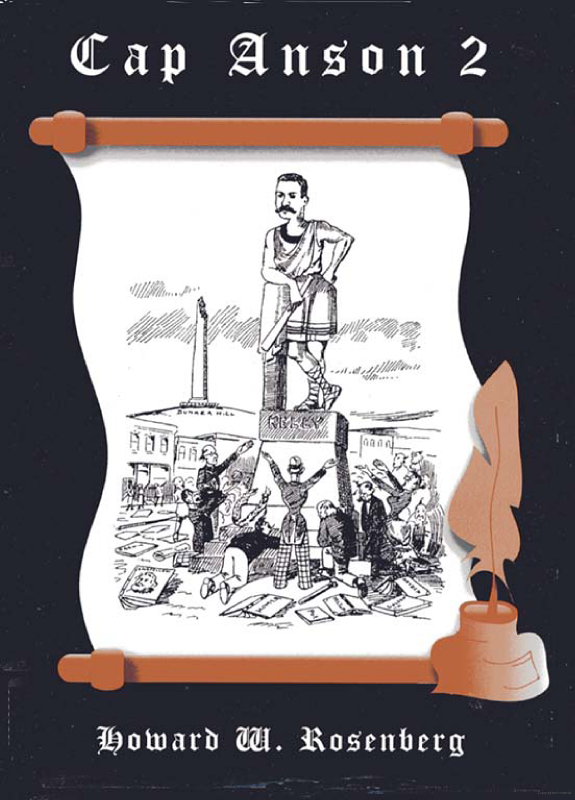
This is the definitive biography of the Hall of Fame player, Mike Kelly, who was the most likely model, if any single player was, for the title character in Ernest Thayer's 1888 poem ``Casey at the Bat." A year earlier, Kelly became famous when Chicago sold him to Boston for a then-record price of $10,000, about $200,000 today. Until the final year of his life, 1894, he drew exceptionally colorful and informative coverage. In May 2005, the San Diego Union-Tribune called Kelly's 85-page 1888 book one of the ten most influential baseball books of all time ( http://www.signonsandiego.com/sports/baseball/20050516-9999-lz1s16books.html). Kelly's definitive biography fully incorporates those aspects of the 1888 book that provide significant insights into Kelly (the 1888 book was ghostwritten and Cap Anson 2 fully accounts for his ghostwriter's writing elsewhere about Kelly). A 1996 Kelly biography by Scarecrow Press credited Kelly's book to the wrong ghostwriter.Cap Anson 2 also closely integrates Kelly with the one other player with as unusual a personality up to 1900, Cap Anson, his captain-manager for seven seasons and the first player to 3,000 hits. Also detailed are their similar interests off the field, including in acting, hunting and playing billiards. Kelly acted, literally and figuratively, through close associations with members of the Boston Elks, a fraternal group with theatrical ties well into the twentieth century. Kelly was exceptionally colorful (a main nickname, ``The $10,000 Beauty,'' derived from an actress who won a $10,000 beauty contest offered by circus owner Adam Forepaugh) and his funny mannerisms on the field were legendary in Boston until "market-driven journalism'' took hold, leading the Boston Globe and Boston Herald to extinguish their own rich past on Kelly in favor of subscriber- and advertiser-friendly figures such as Ted Williams.More than just an ode to a single player dressed up around already exhausted eras such as the 1940s and 1950s, the Kelly book is also the definitive biography of the actors and musicians most interesting to relate to the national pastime up to 1900: comic actors Nat Goodwin, De Wolf Hopper, Digby Bell and Maurice Barrymore (Drew's great-grandfather); Shakespearean actors Edwin Booth, Lawrence Barrett and Alexander Salvini; playwright Charles Hoyt; lyricist William ``Billy'' Jerome; theatrical agent George W. Floyd; and composer John Philip Sousa.The book's lone appendix, betting on baseball up to 1900 and featuring Hall of Famer Anson, was the most important new historical compliment to Pete Rose's 2004 biography. Cap Anson 2: The Theatrical and Kingly Mike Kelly: U.S. Team Sport's First Media Sensation and Baseball's Original Casey at the Bat is the second in a series of baseball books to piece together, rather than sample, the vast newspaper record of the nineteenth century. Cap Anson 1: When Captaining Meant Something: Leadership in Baseball's Early Years (2003) featured early baseball through the once-significant roles of captains and captain-managers. Cap Anson was a longtime captain (player)-manager of Chicago's National League team, and that was the first book (with the exception of his ghostwritten autobiography in the year 1900), in which he is definitively and independently discussed. This is the second.