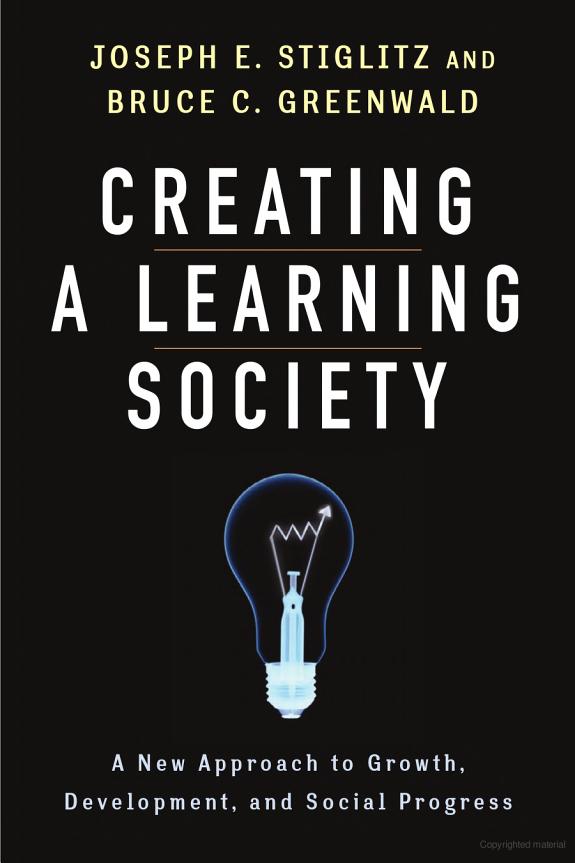
Creating a Learning Society

Creating a Learning Society

A New Approach to Growth, Development, and Social Progress

by Joseph E. Stiglitz, Bruce C. Greenwald

560 pages· 2014· ISBN 9780231525541
About
It has long been recognized that most standard of living increases are associated with advances in technology, not the accumulation of capital. Yet it has also become clear that what truly separates developed from less developed countries is not just a gap in resources or output but a gap in knowledge. In fact, the pace at which developing countries grow is largely determined by the pace at which they close that gap. Therefore, how countries learn and become more productive is key to understanding how they grow and develop, especially over the long term. In Creating a Learning Society, Joseph E. Stiglitz and Bruce C. Greenwald spell out the implications of this insight for both economic theory and policy. Taking as a starting point Kenneth J. ArrowÕs 1962 paper ÒLearning by Doing,Ó they explain why the production of knowledge differs from that of other goods and why market economies alone are typically not efficient in the production and transmission of knowledge. Closing knowledge gaps, or helping laggards learn, is central to growth and development. Combining technical economic analysis with accessible prose, Stiglitz and Greenwald provide new models of Òendogenous growth,Ó upending the received thinking about global policy and trade regimes. They show how well-designed government trade and industrial policies can help create a learning society; explain how poorly designed intellectual property regimes can retard learning; demonstrate how virtually every government policy has effects, both positive and negative, on learning; and they argue that policymakers need to be cognizant of these effects. They provocatively show why many standard policy prescriptions, especially associated with ÒneoliberalÓ doctrines focusing on static resource allocations, impede learning and explain why free trade may lead to stagnation, while broad based industrial protection and exchange rate interventions may bring benefits, not just to the industrial sector, but to the entire economy. The volume concludes with brief commentaries from Philippe Aghion and Michael Woodford, as well as from Nobel Laureates Kenneth Arrow and Robert Solow.

Discuss Creating a Learning Society with other readers

Join or start a book club for Creating a Learning Society on Readfeed. Live chat, shared reading progress, and AI discussion questions — free to get started.

Frequently asked questions

How do I join a book club for Creating a Learning Society?

Sign up free on Readfeed, then browse public clubs or start your own club with Creating a Learning Society as the current read. Invite friends with a share link and discuss together with live chat and AI discussion questions.

Can I discuss Creating a Learning Society with other readers online?

Yes. Readfeed book clubs let you chat live, share progress, and join discussions about Creating a Learning Society with readers worldwide — whether your club is virtual, in-person, or hybrid.

Is Readfeed free?

Yes. Creating an account and joining book clubs is free. Sign up to find readers who love the same books and start discussing today.