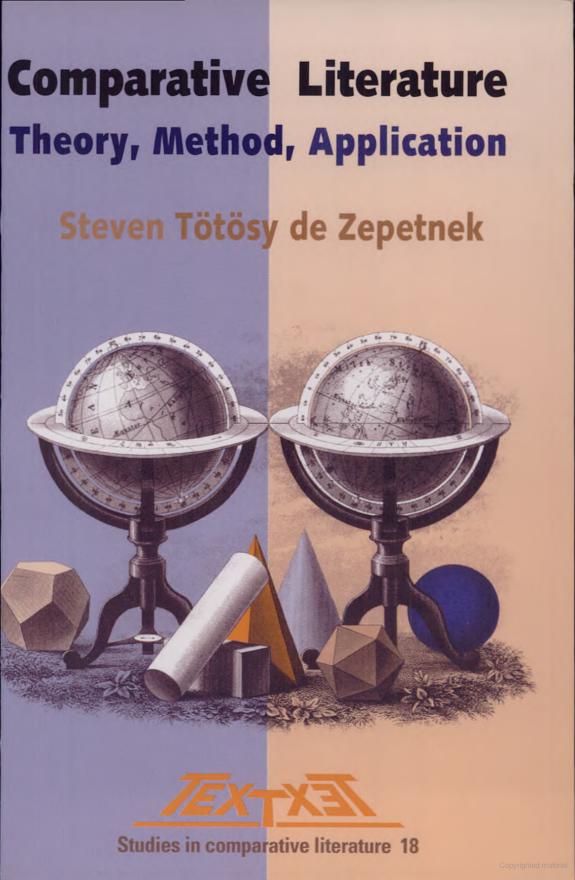
Comparative Literature
Theory, Method, Application
by Steven Tötösy de Zepetnek
297 pages· 1998· ISBN 9789042005341
About
This book serves several purposes, all very much needed in today's embattled situation of the humanities and the study of literature. First, in Chapter One, the author proposes that the discipline of Comparative Literature is a most advantageous approach for the study of literature and culture as it is a priori a discipline of cross-disciplinarity and of international dimensions. After a "Manifesto" for a New Comparative Literature, he proceeds to offer several related theoretical frameworks as a composite method for the study of literature and culture he designates and explicates as the "systemic and empirical approach." Following the introduction of the proposed New Comparative Literature, the author applies his method to a wide variety of literary and cultural areas of inquiry such as "Literature and Cultural Participation" where he discusses several aspects of reading and readership (Chapter Two), "Comparative Literature as/and Interdisciplinarity" (Chapter Three) where he deals with theory and application for film and literature and medicine and literature, "Cultures, Peripheralities, and Comparative Literature" (Chapter Four) where he proposes a theoretical designation he terms "inbetween peripherality" for the study of East Central European literatures and cultures as well as ethnic minority writing, "Women's Literature and Men Writing about Women"(Chapter Five) where he analyses texts written by women and texts about women written by men in the theoretical context of Ethical Constructivism, "The Study of Translation and Comparative Literature" (Chapter Six) where after a theoretical introduction he presents a new version of Anton Popovic's dictionary for literary translation as a taxonomy for the study of translation, and "The Study of Literature and the Electronic Age" (Chapter Seven), where he discusses the impact of new technologies on the study of literature and culture. The analyses in their various applications of the proposed New Comparative Literature involve modern and contemporary authors and their works such as Dorothy Richardson, Margit Kaffka, Mircea Cartarescu, Robert Musil, Alfred Döblin, Hermann Hesse, Péter Esterházy, Dezsö Kosztolányi, Michael Ondaatje, Endre Kukorelly, Else Seel, and others.
Discuss Comparative Literature with other readers
Join or start a book club for Comparative Literature on Readfeed. Live chat, shared reading progress, and AI discussion questions — free to get started.
Frequently asked questions
How do I join a book club for Comparative Literature?
Sign up free on Readfeed, then browse public clubs or start your own club with Comparative Literature as the current read. Invite friends with a share link and discuss together with live chat and AI discussion questions.
Can I discuss Comparative Literature with other readers online?
Yes. Readfeed book clubs let you chat live, share progress, and join discussions about Comparative Literature with readers worldwide — whether your club is virtual, in-person, or hybrid.
Is Readfeed free?
Yes. Creating an account and joining book clubs is free. Sign up to find readers who love the same books and start discussing today.