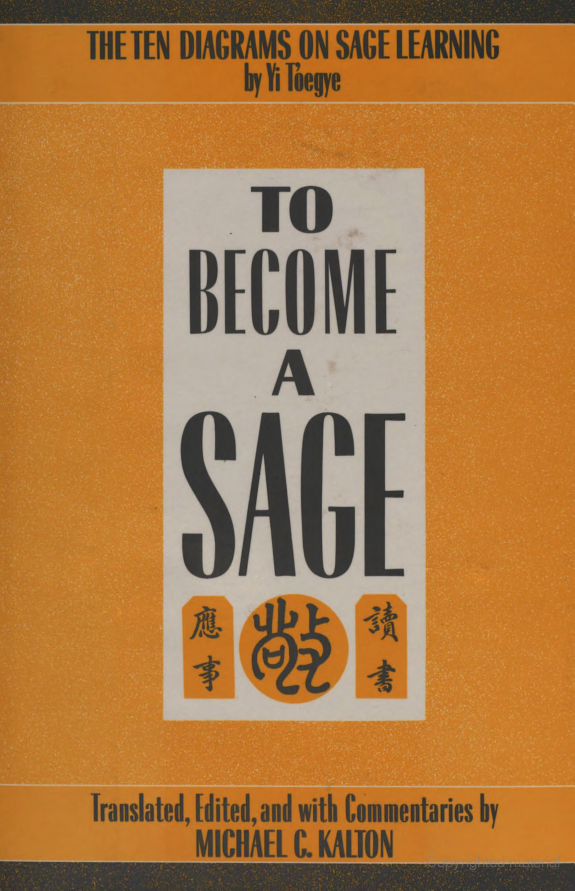
To Become a Sage
The Ten Diagrams on Sage Learning
by Hwang Yi, Michael C. Kalton
278 pages· 1988· ISBN 9780231064101
About
The summation of more than two thousand years of one of the world's most august literary traditions, this volume also represents the achievements of four hundred years of Western scholarship on China. The selections include poetry, drama, fiction, songs, biographies, and works of early Chinese philosophy and history rendered in English by the most renowned translators of classical Chinese literature: Arthur Waley, Ezra Pound, David Hawkes, James Legge, Burton Watson, Stephen Owen, Cyril Birch, A. C. Graham, Witter Bynner, Kenneth Rexroth, and others. Arranged chronologically and by genre, each chapter is introduced by definitive quotes and brief introductions chosen from classic Western sinological treatises. Beginning with discussions of the origins of the Chinese writing system and selections from the earliest "genre" of Chinese literature--the Oracle Bone inscriptions--the book then proceeds with selections from: * early myths and legends; * the earliest anthology of Chinese poetry, the Book of Songs; * early narrative and philosophy, including the I Ching, Tao-te Ching, and the Analects of Confucius; * rhapsodies, historical writings, magical biographies, ballads, poetry, and miscellaneous prose from the Han and Six Dynasties period; * the court poetry of the Southern Dynasties; * the finest gems of Tang poetry; and * lyrics, stories, and tales of the Sui, Tang, and Five Dynasties eras. Special highlights include individual chapters covering each of the luminaries of Tang poetry: Wang Wei, Li Bo, Du Fu, and Bo Juyi; early literary criticism; women poets from the first to the tenth century C.E.; and the poetry of Zen and the Tao. Bibliographies, explanatory notes, copious illustrations, a chronology of major dynasties, and two-way romanization tables coordinating the Wade-Giles and pinyin transliteration systems provide helpful tools to aid students, teachers, and general readers in exploring this rich tradition of world literature.
Discuss To Become a Sage with other readers
Join or start a book club for To Become a Sage on Readfeed. Live chat, shared reading progress, and AI discussion questions — free to get started.
Frequently asked questions
How do I join a book club for To Become a Sage?
Sign up free on Readfeed, then browse public clubs or start your own club with To Become a Sage as the current read. Invite friends with a share link and discuss together with live chat and AI discussion questions.
Can I discuss To Become a Sage with other readers online?
Yes. Readfeed book clubs let you chat live, share progress, and join discussions about To Become a Sage with readers worldwide — whether your club is virtual, in-person, or hybrid.
Is Readfeed free?
Yes. Creating an account and joining book clubs is free. Sign up to find readers who love the same books and start discussing today.