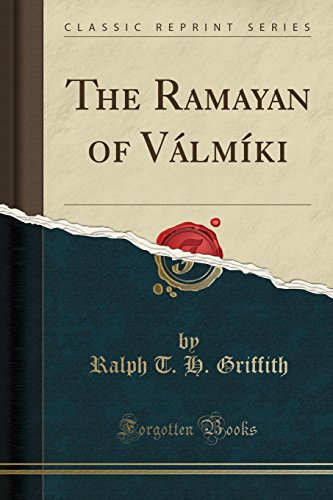
The Ramayan of Válmíki (Classic Reprint)
by Ralph T. H. Griffith
The subject of the Rameyan, the great national epic of the Hindus. Their one com mon and everlasting possesssion. Is, as the name implies,l the life and adventures of Rama. These adventures are bried y summarized in the introductory cantos of the poem and do not require to be dwelt upon here. The great exploit and main subject of the epic is the war which Rama waged with the giant Ravan the fierce and mighty King of Lanka or Ceylon and the dread Oppressor of Gods and nymphs and saints and men. The army,' to borrow the words of Gorresio, which Rama led on this expedi tion was, as appears from the poem, gathered in great part from the region of the Vindhyan hills. But the races which he assembled are represented in the poem as monkeys. Either out of contempt for their barbarism or because at that time they were little known to the Sanskritspeaking Hindus. The people against whom Rama waged war are, as the poem indicates in many places, different in origin, in civiliza tion, and in worship, from the Sanskrit Indians but the poet of the Rameyan, in this respect like Homer who assigns to Troy customs, creeds, and worship similar to those of Greece, places in Ceylon, the seat of this alien and hostile people, names, habits, and worship similar to those of Sanskrit India. The poet calls the people whom Rama attacked Rakshasas. Rakshasas, according to the popular Indian be lief, are malignant beings, demons of many shapes, terrible and cruel, who disturb the sacrifices and the religious rites of the Brahmans. It appears indubitable that the poet of the Rameyan applied the hated name of Rakshasas to an abhorred and hostile people, and that this denomination is here rather an expression of hatred and horror than a real historical name.
About the Publisher
Forgotten Books publishes hundreds of thousands of rare and classic books. Find more at www.forgottenbooks.com
This book is a reproduction of an important historical work. Forgotten Books uses state-of-the-art technology to digitally reconstruct the work, preserving the original format whilst repairing imperfections present in the aged copy. In rare cases, an imperfection in the original, such as a blemish or missing page, may be replicated in our edition. We do, however, repair the vast majority of imperfections successfully; any imperfections that remain are intentionally left to preserve the state of such historical works.
Discuss The Ramayan of Válmíki (Classic Reprint) with other readers
Join or start a book club for The Ramayan of Válmíki (Classic Reprint) on Readfeed. Live chat, shared reading progress, and AI discussion questions — free to get started.
Frequently asked questions
How do I join a book club for The Ramayan of Válmíki (Classic Reprint)?
Sign up free on Readfeed, then browse public clubs or start your own club with The Ramayan of Válmíki (Classic Reprint) as the current read. Invite friends with a share link and discuss together with live chat and AI discussion questions.
Can I discuss The Ramayan of Válmíki (Classic Reprint) with other readers online?
Yes. Readfeed book clubs let you chat live, share progress, and join discussions about The Ramayan of Válmíki (Classic Reprint) with readers worldwide — whether your club is virtual, in-person, or hybrid.
Is Readfeed free?
Yes. Creating an account and joining book clubs is free. Sign up to find readers who love the same books and start discussing today.