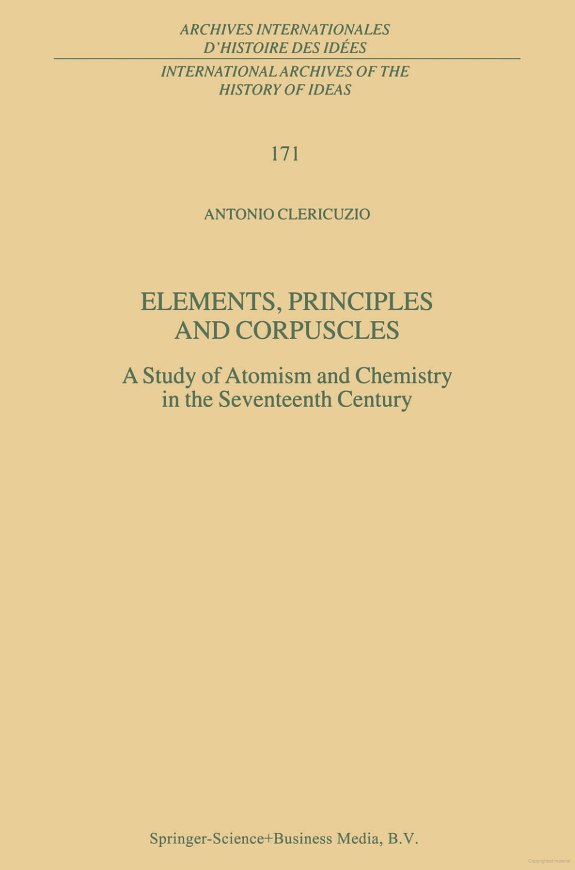
Elements, Principles and Corpuscles

Elements, Principles and Corpuscles

A Study of Atomism and Chemistry in the Seventeenth Century

by Antonio Clericuzio

232 pages· 2013· ISBN 9789401594646
About
In Elements, Principles and Particles, Antonio Clericuzio explores the relationships between chemistry and corpuscular philosophy in the age of the Scientific Revolution. Science historians have regarded chemistry and corpuscular philosophy as two distinct traditions. Clericuzio's view is that since the beginning of the 17th century atomism and chemistry were strictly connected. This is attested by Daniel Sennert and by many hitherto little-known French and English natural philosophers. They often combined a corpuscular theory of matter with Paracelsian chemical (and medical) doctrines. Boyle plays a central part in the present book: Clericuzio redefines Boyle's chemical views, by showing that Boyle did not subordinate chemistry to the principles of mechanical philosophy. When Boyle explained chemical phenomena, he had recourse to corpuscles endowed with chemical, not mechanical, properties. The combination of chemistry and corpuscular philosophy was adopted by a number of chemists active in the last decades of the 17th century, both in England and on the Continent. Using a large number of primary sources, the author challenges the standard view of the corpuscular theory of matter as identical with the mechanical philosophy. He points out that different versions of the corpuscular philosophy flourished in the 17th century. Most of them were not based on the mechanical theory, i.e. on the view that matter is inert and has only mechanical properties. Throughout the 17th century, active principles, as well as chemical properties, are attributed to corpuscles. Given its broad coverage, the book is a significant contribution to both history of science and history of philosophy.

Discuss Elements, Principles and Corpuscles with other readers

Join or start a book club for Elements, Principles and Corpuscles on Readfeed. Live chat, shared reading progress, and AI discussion questions — free to get started.

Frequently asked questions

How do I join a book club for Elements, Principles and Corpuscles?

Sign up free on Readfeed, then browse public clubs or start your own club with Elements, Principles and Corpuscles as the current read. Invite friends with a share link and discuss together with live chat and AI discussion questions.

Can I discuss Elements, Principles and Corpuscles with other readers online?

Yes. Readfeed book clubs let you chat live, share progress, and join discussions about Elements, Principles and Corpuscles with readers worldwide — whether your club is virtual, in-person, or hybrid.

Is Readfeed free?

Yes. Creating an account and joining book clubs is free. Sign up to find readers who love the same books and start discussing today.