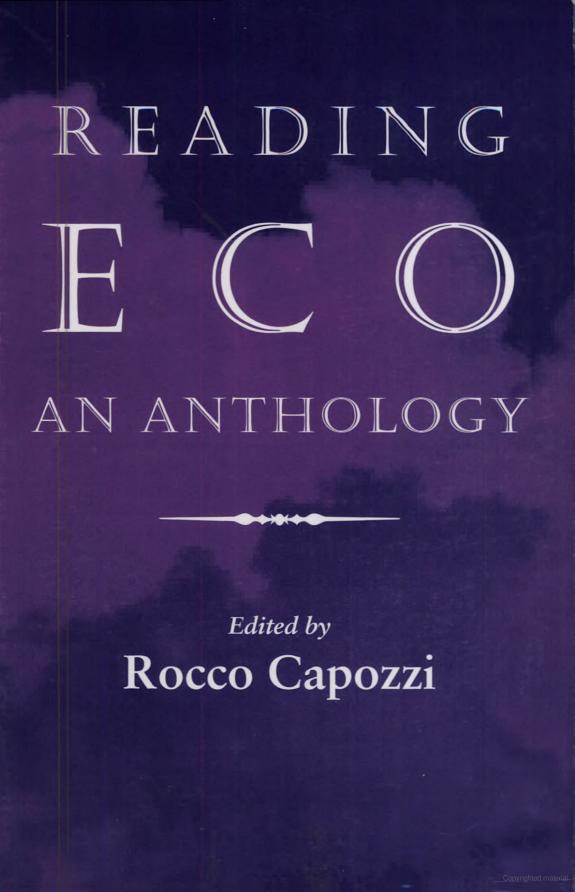
Reading Eco
An Anthology
by Rocco Capozzi
476 pages· 1997· ISBN 9780253211163
About
ÒThe omnivorous range of his ceaselessly roving intelligence over far-reaching epochsÑespecailly the twelfth to fourteenth centuries of his Latinate mythopoeic imaginationÑvast spaces, including a chimerical seventeenth century South Pacific, and an astonishing variety of topics, Ancient and Modern, brings to mind Dr. Johnson's couplet that could serve as Eco's motto: ÔLet observation with extensive view / Survey mankind, from China to Peru.ÕÓ ÑThomas A. Sebeok, from the Foreword ÒWhenever students ask me to give them an idea of what Umberto Eco is ÔreallyÕ like, In person, I often follow their inquiry with my own question: what do Augustine, R. Bacon, T. Aquinas, Templars, Baroque, TV serials like ÔColombo,Õ movies like ÔCasablancaÕ And The trilogy of ÔIndiana JonesÕ; thinkers like Peirce, Bakhtin, Derrida, Foucault, Popper, and Wittengstein; writers like Dante, Poe, Joyce, Borges, Barthes, Lotman; as well as, aesthetics, philosophy, structuralism, semiotics, deconstruction, mass media, Superman, Conan Doyle, esoteric texts, kabbalah, irony, humor, intertextuality, reading the classics, philosophy, comic strips, computers, techniques of writing, and interpreting signs/texts, architecture, libraries, labyrinths, palimpsests, The art of writing bestsellers, Ôglobal encyclopedia,Õ Ôinferential walks,Õ Ôopen works,Õ and 'model readers,Õ have in common? After a few seconds of silence I end up explaining that this is a partial list of authors, topics, theoris, and isses that Eco can examine, discuss and joke about, with various degrees of authority.Ó ÑRocco Capozzi, from the Preface Umberto Eco is, quite simply, a genius. He is a renowned medievalist, philosopher, novelist, a popular journalist, and linguist. He is as warm and witty as he is learned. He is probably the best-known academic and novelist in the world today. The goal of this anthology is to examine his ideas of literary semiotics and interpretation as evidenced both in his scholarly work and in his fiction. The contributors include: Thomas A. Sebeok, Rocco Capozzi, Davis Seed, John Deely, Lubomir Dolezel, Susan Petrilli, Irmengard Rauch, Victorino Tejera, Hanna Buczynska-Garewicz, Michael Riffaterre, Paul Perron, Roberta Kevelson, Anna Longoni, Rocco Capozzi, Teresa De Lauretis, David H. Richter, Peter Bondanella, Thomas Coletti, Linda Hutcheon, Lois Parkinson Zamora, Noram Bouchard, and Claudia Miranda Umberto Eco, best known for his novels, The Name of the Rose, Foucault's Pendulum, And The Island of the Day Before, has also written numerous scholarly books, including A Theory of Semiotics, Semiotics And The Philosophy of Language, The Limits of Interpretation, and Apocalypse Postponed, all from Indiana University Press.
Discuss Reading Eco with other readers
Join or start a book club for Reading Eco on Readfeed. Live chat, shared reading progress, and AI discussion questions — free to get started.
Frequently asked questions
How do I join a book club for Reading Eco?
Sign up free on Readfeed, then browse public clubs or start your own club with Reading Eco as the current read. Invite friends with a share link and discuss together with live chat and AI discussion questions.
Can I discuss Reading Eco with other readers online?
Yes. Readfeed book clubs let you chat live, share progress, and join discussions about Reading Eco with readers worldwide — whether your club is virtual, in-person, or hybrid.
Is Readfeed free?
Yes. Creating an account and joining book clubs is free. Sign up to find readers who love the same books and start discussing today.