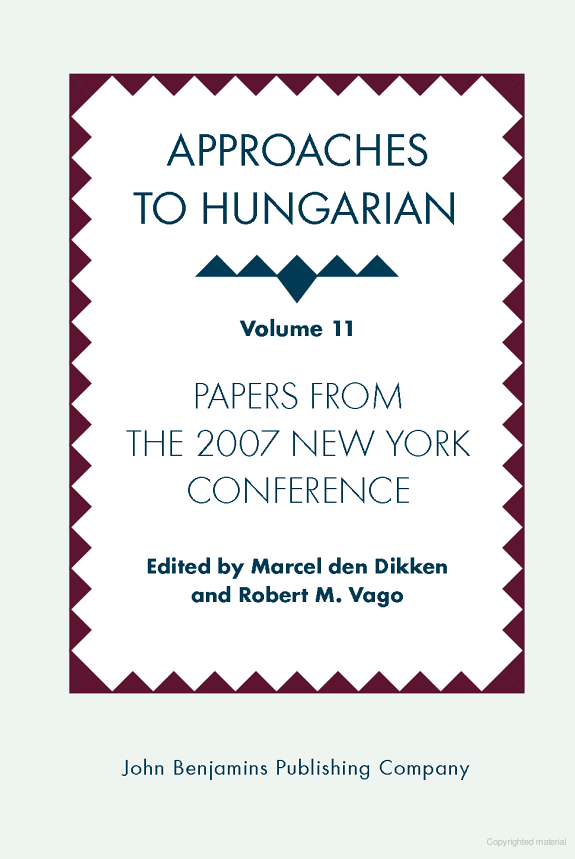
Approaches to Hungarian

Approaches to Hungarian

Volume 11: Papers from the 2007 New York Conference

by Marcel den Dikken, Robert M. Vago

280 pages· 2009· ISBN 9789027288875
About
This volume brings together ten papers, all presented at the 8th International Conference on the Structure of Hungarian (New York City, 2007), addressing a wide range of topics in the morphology, phonetics, phonology, pragmatics, semantics, and syntax of Hungarian, with discussion of related facts in other languages as well. The volume includes an analysis of the morphophonology of the infinitival suffix in Optimality Theory, a plea for a phonetically-grounded theory of phonology based on partial neutralization of the v/f contrast, a Government Phonology account of vowel/zero alternations, a discussion of the recursive nature of speech prosody, a context-structure perspective on the pragmatics of polarity particles, a novel outlook on the prosody, semantics, and syntax of negative quantifiers, a structural approach to the difference between factive and non-factive complements and the distribution of the clausal expletive azt, a pioneering study of the licensing and position of overt nominative subjects of infinitival complement clauses, a lexicalist perspective on the distribution of ablative cause-PPs in anti-causative constructions, and an analysis of the complicated morphosyntax of adpositional preverbs and their doubling in terms of partial chain reduction in a phase-based cyclic mapping of syntax to phonology. The volume will be of interest not just to scholars working on Hungarian, but to a general audience of generative linguists.

Discuss Approaches to Hungarian with other readers

Join or start a book club for Approaches to Hungarian on Readfeed. Live chat, shared reading progress, and AI discussion questions — free to get started.

Frequently asked questions

How do I join a book club for Approaches to Hungarian?

Sign up free on Readfeed, then browse public clubs or start your own club with Approaches to Hungarian as the current read. Invite friends with a share link and discuss together with live chat and AI discussion questions.

Can I discuss Approaches to Hungarian with other readers online?

Yes. Readfeed book clubs let you chat live, share progress, and join discussions about Approaches to Hungarian with readers worldwide — whether your club is virtual, in-person, or hybrid.

Is Readfeed free?

Yes. Creating an account and joining book clubs is free. Sign up to find readers who love the same books and start discussing today.