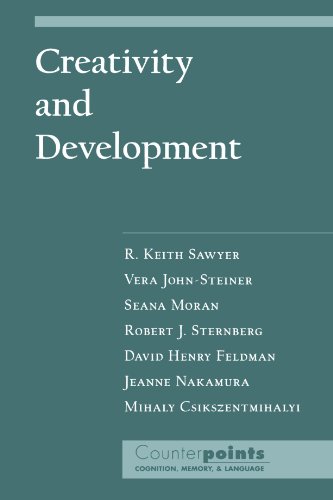
Creativity and Development (Counterpoints: Cognition, Memory, and Language)

Creativity and Development (Counterpoints: Cognition, Memory, and Language)

by Robert J. Sternberg, Howard Gardner, Mihaly Csikszentmihalyi, Seana Moran, Vera John-Steiner, R. Keith Sawyer, David Henry Feldman, Jeanne Nakamura

256 pages· 2003· ISBN 9780195149005
About
What is creativity, and where does it come from? Creativity and Development explores the fascinating connections and tensions between creativity research and developmental psychology, two fields that have largely progressed independently of each other-until now. In this book, scholars influential in both fields explore the emergence of new ideas, and the development of the people and situations that bring them to fruition. The uniquely collaborative nature of Oxford's Counterpoints series allows them to engage in a dialogue, addressing the key issues and potential benefits of exploring the connections between creativity and development. Creativity and Development is based on the observation that both creativity and development are processes that occur in complex systems, in which later stages or changes emerge from the prior state of the system. In the 1970s and 1980s, creativity researchers shifted their focus from personality traits to cognitive and social processes, and the co-authors of this volume are some of the most influential figures in this shift. The central focus on system processes results in three related volume themes: how the outcomes of creativity and development emerge from dynamical processes, the interrelation between individual processes and social processes, and the role of mediating artifacts and domains in developmental and creative processes. The chapters touch on a wide range of important topics, with the authors drawing on their decades of research into creativity and development. Readers will learn about the creativity of children's play, the creative aspects of children's thinking, the creative processes of scientists, the role of education and teaching in creative development, and the role of multiple intelligences in both creativity and development. The final chapter is an important dialogue between the authors, who engage in a roundtable discussion and explore key questions facing contemporary researchers, such as: Does society suppress children's creativity? Are creativity and development specific to an intelligence or a domain? What role do social and cultural contexts play in creativity and development? Creativity and Development presents a powerful argument that both creativity scholars and developmental psychologists will benefit by becoming more familiar with each other's work.

Discuss Creativity and Development (Counterpoints: Cognition, Memory, and Language) with other readers

Join or start a book club for Creativity and Development (Counterpoints: Cognition, Memory, and Language) on Readfeed. Live chat, shared reading progress, and AI discussion questions — free to get started.

Frequently asked questions

How do I join a book club for Creativity and Development (Counterpoints: Cognition, Memory, and Language)?

Sign up free on Readfeed, then browse public clubs or start your own club with Creativity and Development (Counterpoints: Cognition, Memory, and Language) as the current read. Invite friends with a share link and discuss together with live chat and AI discussion questions.

Can I discuss Creativity and Development (Counterpoints: Cognition, Memory, and Language) with other readers online?

Yes. Readfeed book clubs let you chat live, share progress, and join discussions about Creativity and Development (Counterpoints: Cognition, Memory, and Language) with readers worldwide — whether your club is virtual, in-person, or hybrid.

Is Readfeed free?

Yes. Creating an account and joining book clubs is free. Sign up to find readers who love the same books and start discussing today.