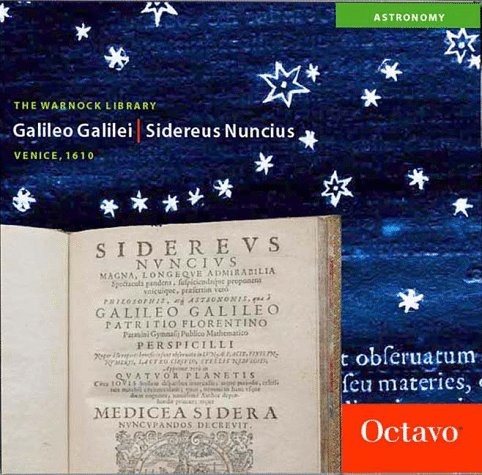
Sidereus Nuncius (Latin Edition)
by Galileo Galilei
The age of the telescope began modestly with a patent application in 1608 for a three-powered spyglass, filed with the Dutch Republic by a spectacle maker from Middleburg, Hans Lipperhey. News of the device traveled quickly to other parts of Europe, and when Galileo heard about it in the spring of 1609, he built his own instrument, a three-powered spyglass with a convex objective lens and a concave ocular lens that he bought in a spectacle-maker’s shop. By the end of August, he presented an eight-powered telescope of his own devising to the Venetian senate. By November, Galileo had fashioned a twenty-powered telescope, and with it he undertook to observe the Moon, discovering that its surface was rugged and mountainous rather than perfect, as would befit a heavenly body according to classical cosmology. Galileo began writing up his lunar research in January 1610.
Commentary by Albert Van Helden, searchable English translation and Latin live text.
Discuss Sidereus Nuncius (Latin Edition) with other readers
Join or start a book club for Sidereus Nuncius (Latin Edition) on Readfeed. Live chat, shared reading progress, and AI discussion questions — free to get started.
Frequently asked questions
How do I join a book club for Sidereus Nuncius (Latin Edition)?
Sign up free on Readfeed, then browse public clubs or start your own club with Sidereus Nuncius (Latin Edition) as the current read. Invite friends with a share link and discuss together with live chat and AI discussion questions.
Can I discuss Sidereus Nuncius (Latin Edition) with other readers online?
Yes. Readfeed book clubs let you chat live, share progress, and join discussions about Sidereus Nuncius (Latin Edition) with readers worldwide — whether your club is virtual, in-person, or hybrid.
Is Readfeed free?
Yes. Creating an account and joining book clubs is free. Sign up to find readers who love the same books and start discussing today.