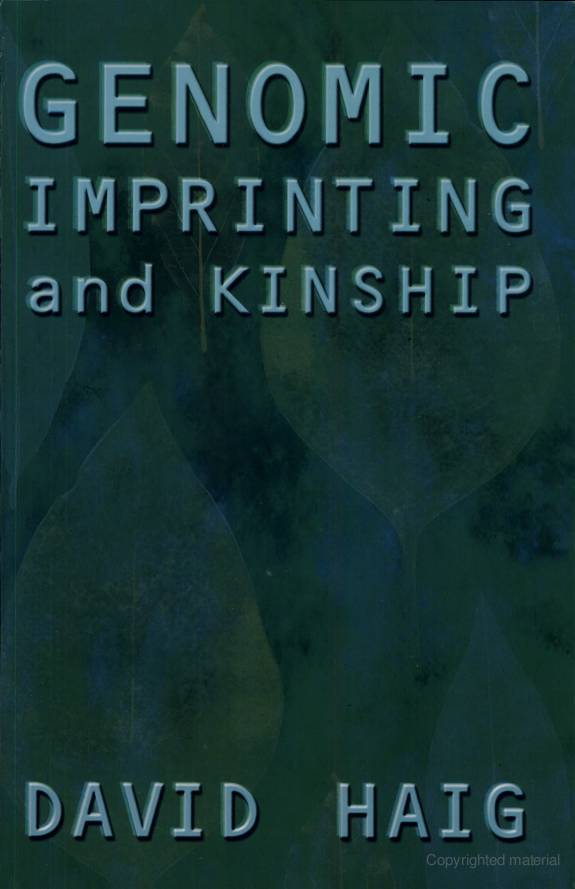
Genomic Imprinting and Kinship
by David Haig
218 pages· 2002· ISBN 9780813530277
About
Until twenty years ago we had no idea which of our genes came from our father and which came from our mother. We took it for granted that our genes expressed themselves identically and that there was a 50/50 chance that they came from either parent. We also assumed that they worked in cooperation with each other. The biggest breakthrough in genetics in the past two decades has been the discovery of genomic imprinting, which allows us to trace genes to the parent of origin. David Haig has been at the forefront of theorizing these developments. He argues that these "paternally and maternally active genes" comprise less than one percent of our total gene count and are far from being cooperative. In fact, they have been shown to be in competition with one another. If Haig's theory holds true, imprinted genes exemplify an extraordinary within-individual conflict, while shaking up our fundamental ideas of what it means to be an individual. This collection of Haig's papers represents a unique comprehensive overview of the state of evolutionary biology. The pages are linked by a commentary that provides background, and brings readers up-to-date on developments that occurred after the paper's original publication. Since genomic imprinting touches on many areas in the life sciences, including evolutionary biology and developmental genetics, Haig's work is scattered through the literature. This volume brings his work together for the first time. A volume in the Rutgers Series in Human Evolution, edited by Robert Trivers. David Haig is an associate professor of organismic and evolutionary biology at Harvard University.
Discuss Genomic Imprinting and Kinship with other readers
Join or start a book club for Genomic Imprinting and Kinship on Readfeed. Live chat, shared reading progress, and AI discussion questions — free to get started.
Frequently asked questions
How do I join a book club for Genomic Imprinting and Kinship?
Sign up free on Readfeed, then browse public clubs or start your own club with Genomic Imprinting and Kinship as the current read. Invite friends with a share link and discuss together with live chat and AI discussion questions.
Can I discuss Genomic Imprinting and Kinship with other readers online?
Yes. Readfeed book clubs let you chat live, share progress, and join discussions about Genomic Imprinting and Kinship with readers worldwide — whether your club is virtual, in-person, or hybrid.
Is Readfeed free?
Yes. Creating an account and joining book clubs is free. Sign up to find readers who love the same books and start discussing today.