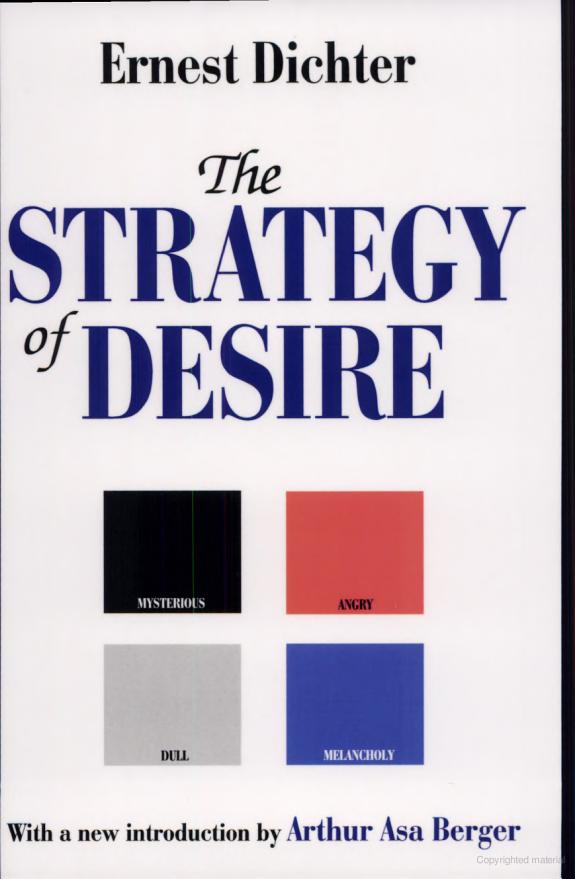
The Strategy of Desire
by Ernest Dichter
314 pages· 1960· ISBN 9781412839228
About
Ernest Dichter is famous as one of the founding fathers of motivational research. In applying the social sciences to a variety of problems, Dichter emphasized new approaches to problem solving, advertising, politics, and selling, and issues of social significance such as urban renewal, productivity, and drug addiction. As an author and corporate adviser, he used psychoanalytic theory and depth interviewing to uncover unconsciously held attitudes and beliefs. He goal was to help explain why people act the way they do and how positive behavioral change might be achieved. In The Strategy of Desire, Dichter both counters the argument that motivational research amounts to manipulation, and shows how the understanding and modification of human behavior is necessary for progress. Dichter's survey and analysis of behavior ranges widely. He examines everyday matters of product choice, as well as such broad civic issues as voter participation, religious toleration, and racial understanding. He shows that in order to achieve socially constructive goals, it is necessary to move beyond theological exhortation, which takes an unrealistic view of human morality, as well as beyond the limits of empirically oriented social science research, which only deals in appearances. Dichter sees human action as rooted in irrational and often unconscious motivation, which can usually be uncovered if the correct approach is used. In his consumer research, he analyzes the nonutilitarian importance of objects in everyday life, as well as how products and materials become bound with emotional resonance or acquire different meanings from different contexts or points of view. Dichter shows that success depends on the satisfaction of desires and a movement beyond the ethic of work and saving. Arguing that in an increasingly technological world, progress and social harmony are materially based, he advocates a morality of the good life in which prosperity and leisure lead to greater human self-assurance in the face of change. First published in 1960, The Strategy of Desire is especially timely in the age of the Internet and ever-increasing effect of sophisticated computer technology on consumer culture. Ernest Dichter (1907-1991) was consulting psychologist for the Columbia Broadcasting System from 1943 to 1946, president of the Institute for Motivational Research, and founder of Ernest Dichter Associates International. His books include, The Psychology of Everyday Life, Handbook of Consumer Motivation, Motivating Human Behavior, and The Naked Manager. Arthur Asa Berger is professor of broadcast and electronic communication arts at San Francisco State University.
Discuss The Strategy of Desire with other readers
Join or start a book club for The Strategy of Desire on Readfeed. Live chat, shared reading progress, and AI discussion questions — free to get started.
Frequently asked questions
How do I join a book club for The Strategy of Desire?
Sign up free on Readfeed, then browse public clubs or start your own club with The Strategy of Desire as the current read. Invite friends with a share link and discuss together with live chat and AI discussion questions.
Can I discuss The Strategy of Desire with other readers online?
Yes. Readfeed book clubs let you chat live, share progress, and join discussions about The Strategy of Desire with readers worldwide — whether your club is virtual, in-person, or hybrid.
Is Readfeed free?
Yes. Creating an account and joining book clubs is free. Sign up to find readers who love the same books and start discussing today.