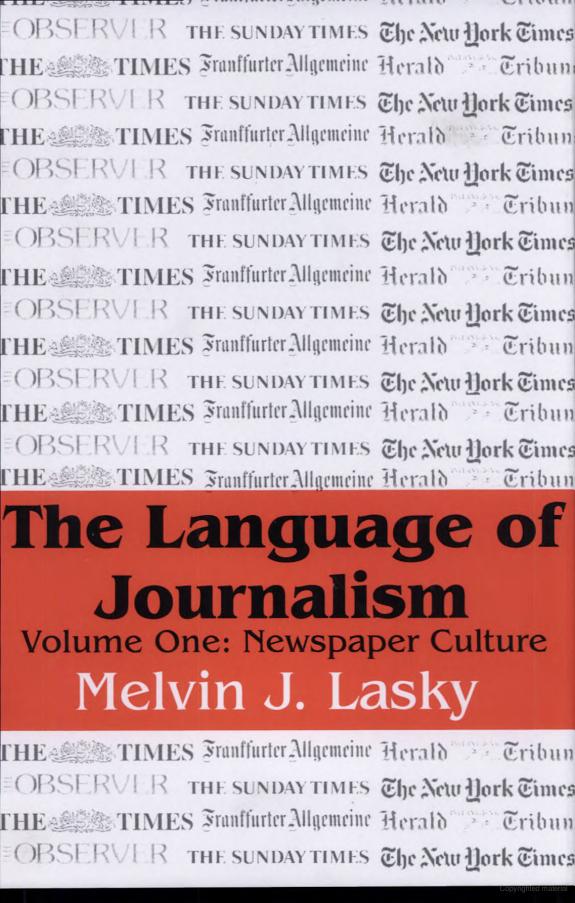
The Language of Journalism
Newspaper culture. Volume one
by Melvin J. Lasky
478 pages· ISBN 9781412837552
About
"Hugely enjoyable--and valuable. I dropped everything else to read it. A treasure..."--Charles Wheeler, senior foreign correspondent, the BBC The newspaper is to the twentieth century what the novel was for the nineteenth century: the expression of popular sentiment. In the first of a three-volume study of journalism and what it has meant as a source of knowledge and as a mechanism for orchestrating mass ideology, Melvin J. Lasky provides a major overview. His research runs the gamut of material found in newspapers, from the trivial to the profound, from pseudo-science to habits of solid investigation. The volume is divided into four parts. The first attacks deficiencies in grammar and syntax with examples from newspapers and magazines drawn from the German as well as English-language press. The second examines the key issues of journalism: accuracy and authenticity. Lasky provides an especially acute account of differences between active literacy and passive viewing, or the relationship of word and picture in defining authenticity. The third part emphasizes the problem of bias in everything from racial reporting to cultural correctness. This is the first systematic attempt to study racial nomenclature, identity-labeling, and literary discrimination. Lasky follows closely the model set by George Orwell a half century earlier. The final section of the work covers the competition between popular media and the redefinition of pornography and its language. The volume closes with an examination of how the popular culture both influenced and was influential upon literary titans like Hemingway, Lawrence, and Tynan. Melvin J. Lasky was the editor of Encounter in England from 1958 until its close in 1990. It was viewed as the most brilliant European periodical of its time. Lasky served as foreign correspondent for the New York Times and The Reporter, and has written for many of the intellectual journals from Partisan Review to Commentary. He is the author of The Hungarian Revolution, Africa for Beginners, Utopia and Revolution, On the Barricades, and Off, and Voices in a Revolution.
Discuss The Language of Journalism with other readers
Join or start a book club for The Language of Journalism on Readfeed. Live chat, shared reading progress, and AI discussion questions — free to get started.
Frequently asked questions
How do I join a book club for The Language of Journalism?
Sign up free on Readfeed, then browse public clubs or start your own club with The Language of Journalism as the current read. Invite friends with a share link and discuss together with live chat and AI discussion questions.
Can I discuss The Language of Journalism with other readers online?
Yes. Readfeed book clubs let you chat live, share progress, and join discussions about The Language of Journalism with readers worldwide — whether your club is virtual, in-person, or hybrid.
Is Readfeed free?
Yes. Creating an account and joining book clubs is free. Sign up to find readers who love the same books and start discussing today.