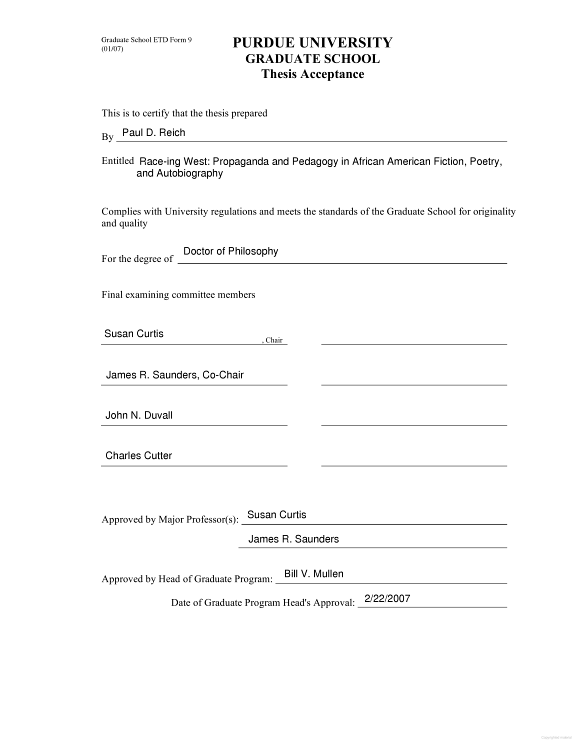
Race-ing West: Propaganda and Pedagogy in African American Fiction, Poetry, and Autobiography

Race-ing West: Propaganda and Pedagogy in African American Fiction, Poetry, and Autobiography

254 pages· 2007· ISBN 9780549302643
About
My dissertation examines selected works of fiction, poetry, and autobiography produced by African Americans writing about the American West. Studies of Western American literature and history have long neglected these contributions to the literary and historical canon, and my work seeks to correct that deficiency. Written from an interdisciplinary perspective that includes literary, historical, racial, and cultural analyses, this study reveals authors who were concerned with contesting popular notions of the American West, re-imagining it as a place of opportunity for African Americans. These authors created instructional texts aimed at both members of their race and those outside of it, promoting their work in a variety of venues. Chapter One examines Pauline Hopkins's Winona, a text often ignored for its reliance on Western and other seemingly incompatible generic elements. I argue that Hopkins's decision to inundate her text with these elements was both experimental and purposeful; mixing genres becomes symbolic for her contention that interracial romance is one path for racial harmony. The next chapter looks at two autobiographies, one by black cowboy Nat Love and the other by the first African American graduate of West Point, Henry Flipper. Both Love and Flipper expose the opportunities in the West but also show its inability to divorce itself from the nation's racial heritage. Chapters Three and Four examine two novels in Oscar Micheaux's South Dakota trilogy. Both novels speak to the author's own experiences in the state yet serve different purposes. A surface reading of The Conquest, for example, positions the author as a proponent for the history of Frederick Jackson Turner and the policies of Booker T. Washington; a more careful reading reveals the subtle critiques Micheaux levies against both men. Chapter Four locates The Homesteader as a response to D.W. Griffith's Birth of a Nation. In his text, Micheaux constructs a protagonist that is honest and successful, combating the negative characterizations found in Griffith's film. The final chapter of my dissertation studies recovered poetry from African American newspapers in Western towns. Those poets, like their literary contemporaries, reveal the complexities of the region while securing their place to imagine it.

Discuss Race-ing West: Propaganda and Pedagogy in African American Fiction, Poetry, and Autobiography with other readers

Join or start a book club for Race-ing West: Propaganda and Pedagogy in African American Fiction, Poetry, and Autobiography on Readfeed. Live chat, shared reading progress, and AI discussion questions — free to get started.

Frequently asked questions

How do I join a book club for Race-ing West: Propaganda and Pedagogy in African American Fiction, Poetry, and Autobiography?

Sign up free on Readfeed, then browse public clubs or start your own club with Race-ing West: Propaganda and Pedagogy in African American Fiction, Poetry, and Autobiography as the current read. Invite friends with a share link and discuss together with live chat and AI discussion questions.

Can I discuss Race-ing West: Propaganda and Pedagogy in African American Fiction, Poetry, and Autobiography with other readers online?

Yes. Readfeed book clubs let you chat live, share progress, and join discussions about Race-ing West: Propaganda and Pedagogy in African American Fiction, Poetry, and Autobiography with readers worldwide — whether your club is virtual, in-person, or hybrid.

Is Readfeed free?

Yes. Creating an account and joining book clubs is free. Sign up to find readers who love the same books and start discussing today.