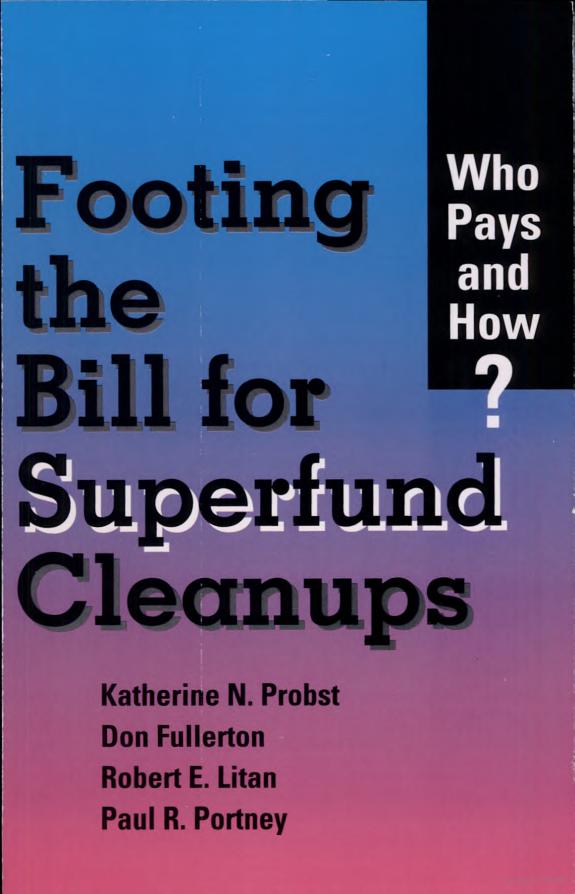
Footing the Bill for Superfund Cleanups

Footing the Bill for Superfund Cleanups

Who Pays and How?

by Katherine Probst, Don Fullerton, Robert Litan, Paul Portney

192 pages· 2010· ISBN 9780815715689
About
One of the difficulties associated with Superfund--the federal government's program for cleaning up toxic waste sites in the United States--is the poor understanding we have about who is actually bearing its costs. While it is known that the tax on chemical and petroleum feedstocks raises about $570 million annually for the Superfund Trust Fund and the corporate environmental tax raises another $460 millino each year, further reliable data are only now becoming available. Researchers are beginning to understand how much potentially responsible parties and their insurers are spending on both transaction costs and on-site cleanups.Unfortunately, this is only the first part of the puzzle. Ultimately, these costs are borne by individuals--as consumers of the products or services provided or as share- or bond-holders, employees, or managers of the company. To date, no one has attempted to estimate the distribution of initial costs under the Superfund liability system or examined carefully the indirect effects of the costs of the Superfund program on other industries.In this book, the authors develop information on who pays the costs and who bears the burden under the current liability scheme in Superfund on a site-by-site basis. They look at short-term financial implications of changes in liability and taxes on key sectors affected by Superfund: chemicals, oil, mining, wood preserving, and commercial property-casualty insurers. They analyze the incidence of different taxing mechanisms and compare and contrast the financial effects on specific industries of the current Superfund program and of several alternative lability and tax-based funding mechanisms available.The alternative liability approaches examined include a scenario in which liability is eliminated for all sites created before Superfund was enacted, as well as a scenario in which parties are released from liability at sites where municipal and industrial wastes were codisposed. Because any change in liability will require a corollary change in trust fund revenues, the authors also assess the economic implications of a variety of taxes that could be used to finance the creation of a larger trust fund for site cleanups. These include an increase in the corporate environmental tax and the implemenation of new taxes, such as an excise tax on commercial insurance.Don Fullerton is a professor of economics and public policy at Carnegie Mellon, H. John Heinz III School of Public Policy and Management. Robert E. Litan, is a senior fellow at Brookings, and formerly was deputy assistant attorney general in the Antitrust Division of the U.S. Department of Justice. Paul R. Portney is vice president and senior fellow at resources for the Future. Katherine N. Probst is a fellow in the Center for Risk Management at Resources for the Future.

Discuss Footing the Bill for Superfund Cleanups with other readers

Join or start a book club for Footing the Bill for Superfund Cleanups on Readfeed. Live chat, shared reading progress, and AI discussion questions — free to get started.

Frequently asked questions

How do I join a book club for Footing the Bill for Superfund Cleanups?

Sign up free on Readfeed, then browse public clubs or start your own club with Footing the Bill for Superfund Cleanups as the current read. Invite friends with a share link and discuss together with live chat and AI discussion questions.

Can I discuss Footing the Bill for Superfund Cleanups with other readers online?

Yes. Readfeed book clubs let you chat live, share progress, and join discussions about Footing the Bill for Superfund Cleanups with readers worldwide — whether your club is virtual, in-person, or hybrid.

Is Readfeed free?

Yes. Creating an account and joining book clubs is free. Sign up to find readers who love the same books and start discussing today.