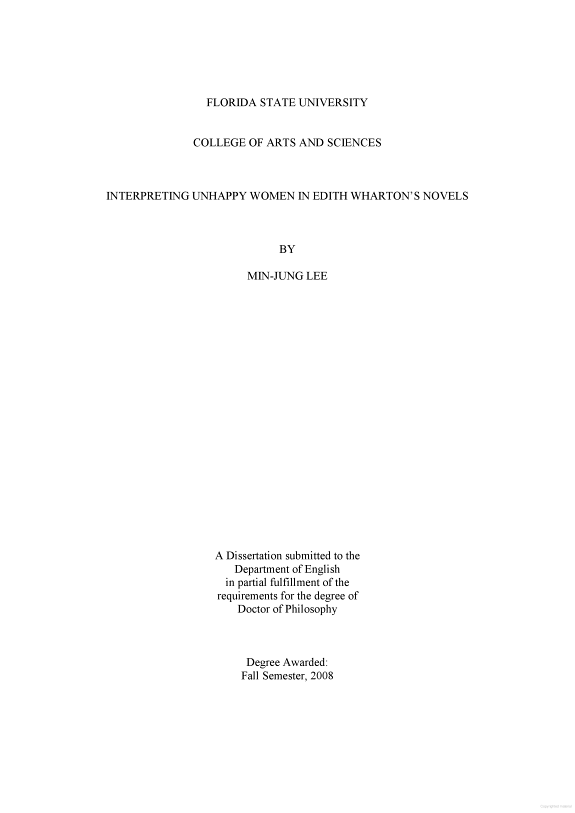
Interpreting Unhappy Women in Edith Wharton's Novels

Interpreting Unhappy Women in Edith Wharton's Novels

178 pages· 2008· ISBN 9781109045864
About
There is nothing new under the sun in human experiences of inevitable disappointment, suffering, and pain derived from imperfect human nature and the reality of human life. This dissertation analyzes female characters that suffer from sorrow, pain, and tribulation in these novels by Edith Wharton: The Age of Innocence (1920), The House of Mirth (1905), The Custom of the Country (1913) and Twilight Sleep (1927). Female characters that I discuss belong to a group of upper-class in New York, ranged from post-Civil War era to post-World War I. I focus on how they cope with complications and endure unhappiness resulting from their limited positions in society and the inadequacy of their marriages. This dissertation aims to explore the social, cultural, and psychological conditions that lead Wharton's female characters toward a new consciousness and to examine how human psychology develops based on the principles of the analytical psychology of Carl Jung and his followers rather than the approach we associate with Sigmund Freud. As feminist scholars have pointed out, Freud's theory does not hold for girls because boys' and girls' Oedipal complexes are not symmetrical. A girl does not simply transfer her affection from mother to father and give up her tender feelings for her mother. Instead, the bond is more likely to be sustained, and the relation to her father is added to it. Girls often come to define themselves more in relation to others, rather than as separate and isolated. The impact of feminist scholarship since the 1970s has restored Wharton's works to the American canon. Having shifted from the external factors to the psychological domain, Wharton's unhappy female characters represent the oppression of what Jung identifies as the Feminine, not of women. The problem lies in the lack of relationship between a woman's ego and her archetypes---both Feminine and Masculine. This study demonstrates how the character's life is shaped by the suppression and distortion, and later, the implosive and explosive power of her evolving Feminine consciousness. Wharton's characters embody her philosophy that paradox is the essence of living, particularly the paradox in the human psyche. Although one longs for harmony, peace and resolution, experiences teach one that it is conflict and failure that stimulate one's growth and evolution to another stage in life.

Discuss Interpreting Unhappy Women in Edith Wharton's Novels with other readers

Join or start a book club for Interpreting Unhappy Women in Edith Wharton's Novels on Readfeed. Live chat, shared reading progress, and AI discussion questions — free to get started.

Frequently asked questions

How do I join a book club for Interpreting Unhappy Women in Edith Wharton's Novels?

Sign up free on Readfeed, then browse public clubs or start your own club with Interpreting Unhappy Women in Edith Wharton's Novels as the current read. Invite friends with a share link and discuss together with live chat and AI discussion questions.

Can I discuss Interpreting Unhappy Women in Edith Wharton's Novels with other readers online?

Yes. Readfeed book clubs let you chat live, share progress, and join discussions about Interpreting Unhappy Women in Edith Wharton's Novels with readers worldwide — whether your club is virtual, in-person, or hybrid.

Is Readfeed free?

Yes. Creating an account and joining book clubs is free. Sign up to find readers who love the same books and start discussing today.