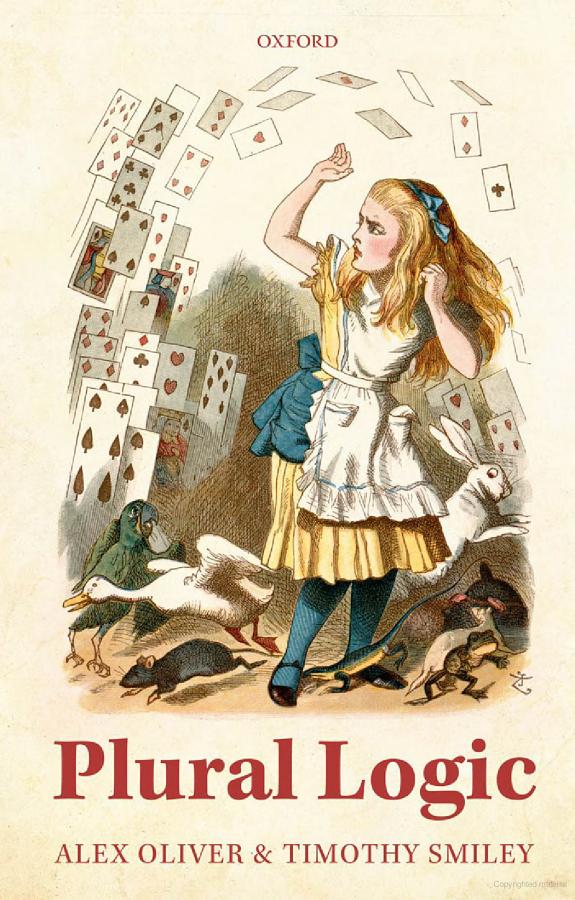
Plural Logic
Second Edition, Revised and Enlarged
by Alex Oliver, Timothy Smiley
352 pages· 2013· ISBN 9780191644115
About
Alex Oliver and Timothy Smiley provide a natural point of entry to what for most readers will be a new subject. Plural logic deals with plural terms ('Whitehead and Russell', 'Henry VIII's wives', 'the real numbers', 'the square root of -1', 'they'), plural predicates ('surrounded the fort', 'are prime', 'are consistent', 'imply'), and plural quantification ('some things', 'any things'). Current logic is singularist: its terms stand for at most one thing. By contrast, the foundational thesis of this book is that a particular term may legitimately stand for several things at once; in other words, there is such a thing as genuinely plural denotation. The authors argue that plural phenomena need to be taken seriously and that the only viable response is to adopt a plural logic, a logic based on plural denotation. They expound a framework of ideas that includes the distinction between distributive and collective predicates, the theory of plural descriptions, multivalued functions, and lists. A formal system of plural logic is presented in three stages, before being applied to Cantorian set theory as an illustration. Technicalities have been kept to a minimum, and anyone who is familiar with the classical predicate calculus should be able to follow it. The authors' approach is an attractive blend of no-nonsense argumentative directness and open-minded liberalism, and they convey the exciting and unexpected richness of their subject. Mathematicians and linguists, as well as logicians and philosophers, will find surprises in this book.
Discuss Plural Logic with other readers
Join or start a book club for Plural Logic on Readfeed. Live chat, shared reading progress, and AI discussion questions — free to get started.
Frequently asked questions
How do I join a book club for Plural Logic?
Sign up free on Readfeed, then browse public clubs or start your own club with Plural Logic as the current read. Invite friends with a share link and discuss together with live chat and AI discussion questions.
Can I discuss Plural Logic with other readers online?
Yes. Readfeed book clubs let you chat live, share progress, and join discussions about Plural Logic with readers worldwide — whether your club is virtual, in-person, or hybrid.
Is Readfeed free?
Yes. Creating an account and joining book clubs is free. Sign up to find readers who love the same books and start discussing today.