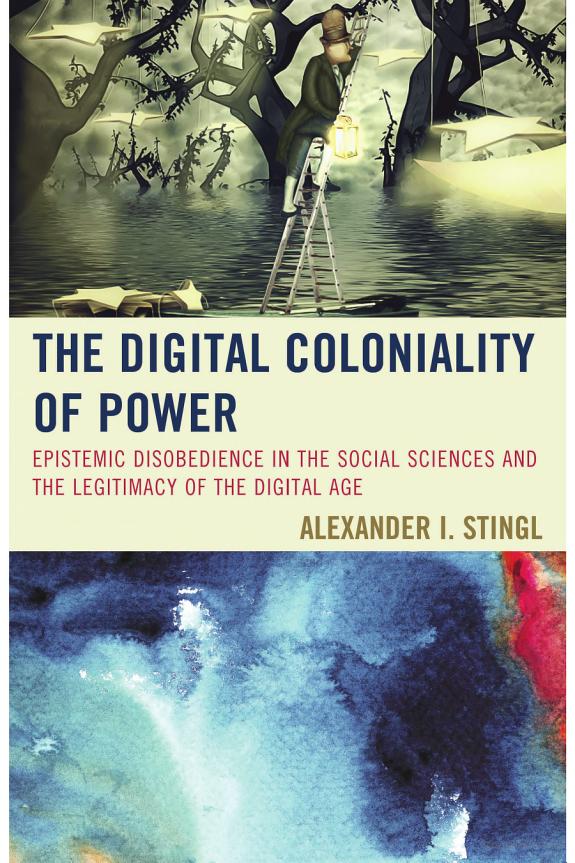
The Digital Coloniality of Power

The Digital Coloniality of Power

Epistemic Disobedience in the Social Sciences and the Legitimacy of the Digital Age

by Alexander I. Stingl

474 pages· 2015· ISBN 9781498501934
About
Trouble is afoot in Digital Culture and Nerdland. These are, Alexander I. Stingl claims, not the engine of freedom and democracy that they once were hailed to be – this much is already clear in the wake of the snooping and surveillance crises that broke in recent years. Digitalization is but another version of the coloniality of power and being that has been at work for decades and centuries. He poses the question, whether Digital Age possess the legitimacy that ‘digitalization’ has claimed. His response is critically realistic, but he doesn’t stop at a critique for criticism’s sake. Inspired by the ideas of decolonial scholars, feminist science studies, current biological and neuro-cognitive research, and sociologists capable of reflection and self-criticism, Stingl attempts to ‘break’ the canvas of sociology and show that adding a third and decolonial dimension to the two-dimensional sociological imagination is indeed possible. He illustrates that it is possible that class-rooms, free speech on internet, and the inequalities in the production and distribution of a new form of social capital – digital cultural health care capital – can be subjected to a decolonial perspective along a sociological line of inquiry, if sociologists allow for relations with other disciplines and scholarship to be integrative conversations. The goal of this book is not to offer results or closed arguments but to create, instead, platforms for thinking further, opening new lines of inquiry, and to argue that it is not enough to identify problems or to attempt solve the problems with politics or best practice solutions. Instead, he proposes, we must learn to identify and make use of the opportunities that are produced by any problem. Stingl’s conclusion is, in short, that a sociology that takes the decolonial challenge and critique seriously, can not be a sociological (sub)discipline or a sociology of (a) problem, but it must be a sociology of opportunities.

Discuss The Digital Coloniality of Power with other readers

Join or start a book club for The Digital Coloniality of Power on Readfeed. Live chat, shared reading progress, and AI discussion questions — free to get started.

Frequently asked questions

How do I join a book club for The Digital Coloniality of Power?

Sign up free on Readfeed, then browse public clubs or start your own club with The Digital Coloniality of Power as the current read. Invite friends with a share link and discuss together with live chat and AI discussion questions.

Can I discuss The Digital Coloniality of Power with other readers online?

Yes. Readfeed book clubs let you chat live, share progress, and join discussions about The Digital Coloniality of Power with readers worldwide — whether your club is virtual, in-person, or hybrid.

Is Readfeed free?

Yes. Creating an account and joining book clubs is free. Sign up to find readers who love the same books and start discussing today.