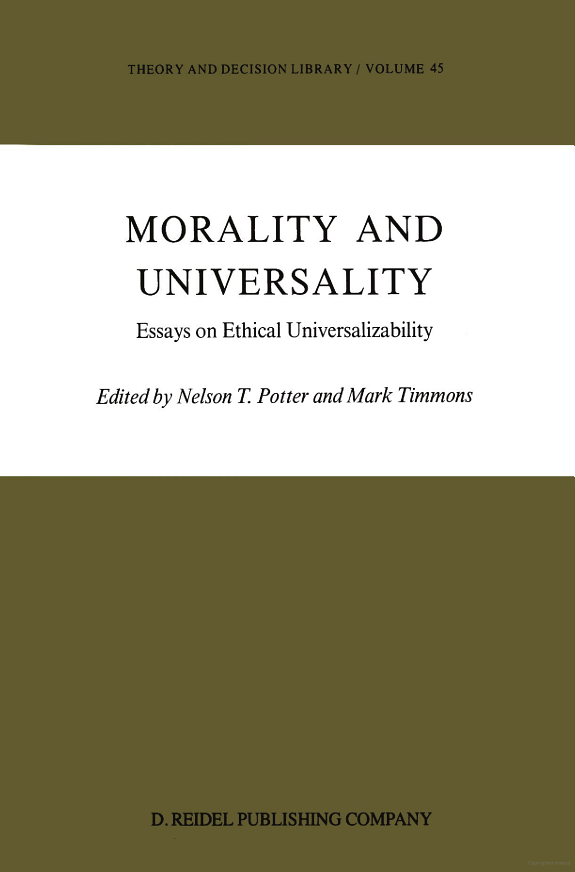
Morality and Universality

Morality and Universality

Essays on Ethical Universalizability

by N.T. Potter, Mark Timmons

314 pages· 2012· ISBN 9789400952850
About
In the past 25 years or so, the issue of ethical universalizability has figured prominently in theoretical as well as practical ethics. The term, 'universaliz ability' used in connection with ethical considerations, was apparently first introduced in the mid-1950s by R. M. Hare to refer to what he characterized as a logical thesis about certain sorts of evaluative sentences (Hare, 1955). The term has since been used to cover a broad variety of ethical considerations including those associated with the ideas of impartiality, consistency, justice, equality, and reversibility as well as those raised in the familar questions: 'What if everyone did that?' and 'How would you like it if someone did that to you? But this recent effloresence of the use of the term 'universalizability' is something that has deep historical roots, and has been central in various forms to the thinking about morality of some of the greatest and most influential philosophers in the western tradition. While the term is relatively new, the ideas it is now used to express have a long history. Most of these ideas and questions have been or can be formulated into a principle to be discussed, criticized, or defended. As we discuss these ideas below this prin ciple will be stated on a separate numbered line. The concepts of justice and equality were closely linked in Greek thought. These connections between these two concepts are apparent even in two authors who were hostile to the connection, Plato and Aristotle.

Discuss Morality and Universality with other readers

Join or start a book club for Morality and Universality on Readfeed. Live chat, shared reading progress, and AI discussion questions — free to get started.

Frequently asked questions

How do I join a book club for Morality and Universality?

Sign up free on Readfeed, then browse public clubs or start your own club with Morality and Universality as the current read. Invite friends with a share link and discuss together with live chat and AI discussion questions.

Can I discuss Morality and Universality with other readers online?

Yes. Readfeed book clubs let you chat live, share progress, and join discussions about Morality and Universality with readers worldwide — whether your club is virtual, in-person, or hybrid.

Is Readfeed free?

Yes. Creating an account and joining book clubs is free. Sign up to find readers who love the same books and start discussing today.