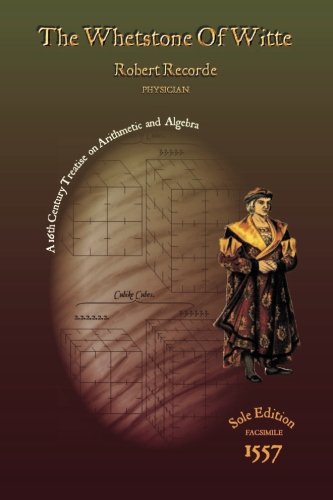
The Whetstone of Witte
by Robert Recorde
360 pages· 2013· ISBN 9781482589306
About
The sole edition of Robert Recorde's The Whetstone of Witte was printed at London by John Kingston in 1557. One of Recorde's concerns in this book is to develop not only a means of representing powers of numbers, but also a means of naming them. Prior to the development of a numerical index notation, the names given to the powers was of considerable importance. Hence in these pages we find terminology which is now archaic, for instance the strange word zenzizenzizenzike, the name for the eighth power of a number. It is generally acknowledged that Recorde's treatise on algebra, in the section entitled The arte of cossike numbers, is the first to be printed in the English language. Although this work owes much to the German mathematicians Christoff Rudolff and Michael Stifel, it does have one well known claim to originality; the first use of two parallel lines as the sign for equality (because noe 2 thyngs, can be moare equalle). Recorde's invention of the equals sign =, together with his adoption of the + sign (which betokeneth more) and the minus sign – (which betokeneth less) placed him at the very forefront of European practice. Like most of Recorde's books, The Whetstone is written in the form of a dialogue between a learned master and a clever, but rather precocious, scholar. After being patiently encouraged through the seconde parte of arithmetic (begun by the scholar in Recorde's first book, The Grounde of Artes) followed by the extraction of rootes, the scholar remarks 'I am moche bounde unto you … Trusting so to applie my studie, and emploie my knowlege, that it shall never repente you of your curtesie in this behalfe'. To which the master, about to start an exposition on the difficult and strange cossike arte (algebra), replies 'Then marke well my words, and you shall perceive, that I will use as moche plainesse, as I maie, in teaching : And therefore will beginne with cossick numbers first'. Here Recorde is again using terminology that is now archaic. In his day algebra was called the cossic art, derived from the Latin cosa, meaning 'thing'. The Whetstone also includes a lengthy treatise on the arte of surde nombers, that is, on irrational numbers.
Discuss The Whetstone of Witte with other readers
Join or start a book club for The Whetstone of Witte on Readfeed. Live chat, shared reading progress, and AI discussion questions — free to get started.
Frequently asked questions
How do I join a book club for The Whetstone of Witte?
Sign up free on Readfeed, then browse public clubs or start your own club with The Whetstone of Witte as the current read. Invite friends with a share link and discuss together with live chat and AI discussion questions.
Can I discuss The Whetstone of Witte with other readers online?
Yes. Readfeed book clubs let you chat live, share progress, and join discussions about The Whetstone of Witte with readers worldwide — whether your club is virtual, in-person, or hybrid.
Is Readfeed free?
Yes. Creating an account and joining book clubs is free. Sign up to find readers who love the same books and start discussing today.