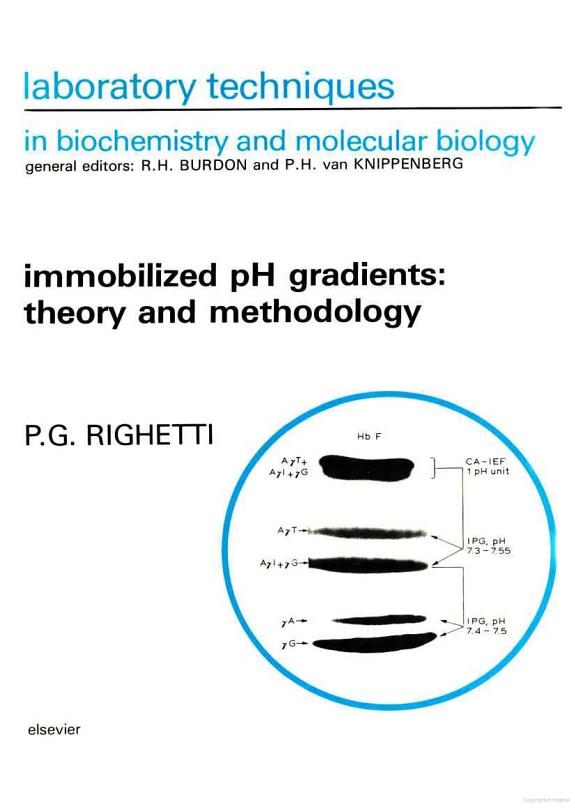
Immobilized pH Gradients: Theory and Methodology

Immobilized pH Gradients: Theory and Methodology

by Pier Giorgio Righetti

396 pages· 1990· ISBN 9780080858890
About
Immobilized pH gradients (IPG) represent the most advanced development of isoelectric focusing (IEF). Originally developed to overcome all the problems of IEF in soluble amphoteric buffers (CA) (such as pH gradient instability, complexation with CA chemicals, unreproducibility of pH gradients, protein precipitation at the pI), it turned out to be an entirely new technique, quite different in principle and operation from conventional IEF. The book is thus meant to bring the reader up to date with this fast developing field. The book is divided into six chapters containing information on: detailed treatment of all the chemistry of the Immobiline chemicals; theory of pH gradient generation (computer simulations, tables with all the possible pH recipes); all analytical aspects of IPGs, including staining techniques, blotting etc.; two-dimensional maps, with a detailed treatise of advantages and limitations; preparative aspects of IPGs, including comparison with other preparative electrophoretic techniques; some examples of applications, including genetic and forensic analysis, blood polymorphism etc. The book is extensive and up-to-date, while also extensively covering the theory. Clearly written, with easily accessible information, the volume is a worthy asset to the Lab. Techniques series.

Discuss Immobilized pH Gradients: Theory and Methodology with other readers

Join or start a book club for Immobilized pH Gradients: Theory and Methodology on Readfeed. Live chat, shared reading progress, and AI discussion questions — free to get started.

Frequently asked questions

How do I join a book club for Immobilized pH Gradients: Theory and Methodology?

Sign up free on Readfeed, then browse public clubs or start your own club with Immobilized pH Gradients: Theory and Methodology as the current read. Invite friends with a share link and discuss together with live chat and AI discussion questions.

Can I discuss Immobilized pH Gradients: Theory and Methodology with other readers online?

Yes. Readfeed book clubs let you chat live, share progress, and join discussions about Immobilized pH Gradients: Theory and Methodology with readers worldwide — whether your club is virtual, in-person, or hybrid.

Is Readfeed free?

Yes. Creating an account and joining book clubs is free. Sign up to find readers who love the same books and start discussing today.