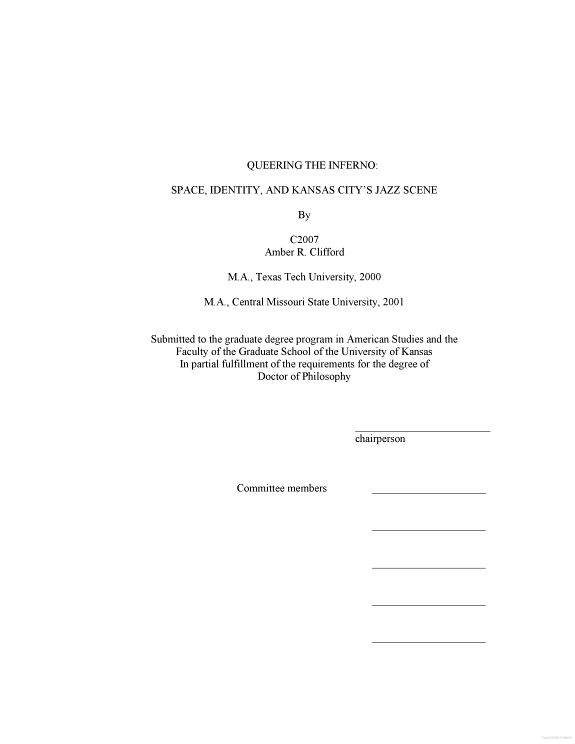
Queering the Inferno: Space, Identity, and Kansas City's Jazz Scene

Queering the Inferno: Space, Identity, and Kansas City's Jazz Scene

332 pages· 2007· ISBN 9780549132486
About
The music later called "jazz" flourished in Kansas City from the 1890s until the end of World War II, when city boss Tom Pendergast's patronage of jazz clubs ended with his incarceration for tax evasion. The city was home to a wide array of clubs, cabarets and performers from every corner of America. As a railroad terminus, the jazz scene in Kansas City was the last stop on performance circuits such as the Theatre Owner's Booking Association (TOBA). While famous people and events of the jazz scene remain in popular memory, many other important aspects of the complex jazz scene were silenced by the grand narrative of jazz history. What about the lives and experiences of brothel madams, drag performers, table dancers, and other citizens who do not appear in the written history of Kansas City jazz? This dissertation will attempt to excavate the lived experience of those Kansas City jazz scene citizens through an analysis of its geography of desires. Geography of desires is an attempt to understand the complexity of life in Kansas City's jazz scene in spatial terms. It is also an approach intended to answer an important question: did citizens who considered themselves marginalized in the Kansas City jazz scene engage in what Jose Esteban Munoz termed "worldmaking" in spaces they identified as "theirs?" Through the geography of desires, I theorize that cabarets, drag clubs and brothels in Kansas City also served as worldmaking spaces. In order to explore the role that jazz scene spaces played in worldmaking, this work attempts an intersectional analysis of the performance of gender, sexuality, class and race in Kansas City. The first chapter focuses on the theoretical underpinnings of the geography of desires approach. The second chapter examines the grand narrative of jazz history as it represents Kansas City. The third chapter explores the intersections of identity in the Pendergast machine. Gender transgression in the jazz scene is the focus of the fourth chapter. Prostitution and sex tourism are the center of chapter four. Finally, chapter five investigates the life of table singer Edna Mae Jacobs.

Discuss Queering the Inferno: Space, Identity, and Kansas City's Jazz Scene with other readers

Join or start a book club for Queering the Inferno: Space, Identity, and Kansas City's Jazz Scene on Readfeed. Live chat, shared reading progress, and AI discussion questions — free to get started.

Frequently asked questions

How do I join a book club for Queering the Inferno: Space, Identity, and Kansas City's Jazz Scene?

Sign up free on Readfeed, then browse public clubs or start your own club with Queering the Inferno: Space, Identity, and Kansas City's Jazz Scene as the current read. Invite friends with a share link and discuss together with live chat and AI discussion questions.

Can I discuss Queering the Inferno: Space, Identity, and Kansas City's Jazz Scene with other readers online?

Yes. Readfeed book clubs let you chat live, share progress, and join discussions about Queering the Inferno: Space, Identity, and Kansas City's Jazz Scene with readers worldwide — whether your club is virtual, in-person, or hybrid.

Is Readfeed free?

Yes. Creating an account and joining book clubs is free. Sign up to find readers who love the same books and start discussing today.