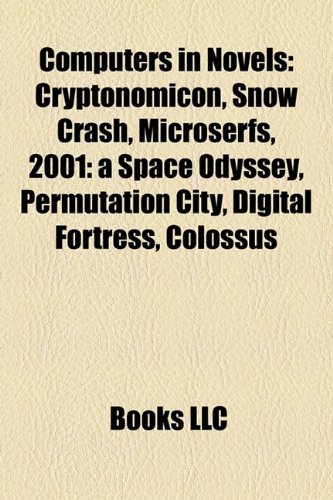
Computers in Novels
Cryptonomicon, Snow Crash, Microserfs 2001
by Books LLC
88 pages· 2010· ISBN 9781155697895
About
Please note that the content of this book primarily consists of articles available from Wikipedia or other free sources online. Commentary (novels not included). Pages: 23. Chapters: Cryptonomicon, Snow Crash, Microserfs, 2001: A Space Odyssey, Permutation City, Digital Fortress, Daemon, Colossus, The Fall of Colossus, Colossus and the Crab, True Names, Science Fair, The God Machine, The Cambridge Quintet. Excerpt: 2001: A Space Odyssey (1968) is a science fiction novel by Arthur C. Clarke. It was developed concurrently with Stanley Kubrick's film version and published after the release of the film. The story is based in part on various short stories by Clarke, most notably "The Sentinel" (written in 1948 for a BBC competition but first published in 1951 under the title "Sentinel of Eternity"). For an elaboration of Clarke and Kubrick's collaborative work on this project, see The Lost Worlds of 2001, Arthur C. Clarke, Signet, 1972. The first part of the novel (in which aliens influence the primitive human ancestors) is similar to the plot of an earlier Clarke story, "Encounter in the Dawn." In the background to the story in the book, an ancient and unseen alien race uses a device with the appearance of a large crystalline monolith to investigate worlds all across the galaxy and, if possible, to encourage the development of intelligent life. The book shows one such monolith appearing in ancient Africa, 3 million years B.C. (in the movie, this was altered to 4 million years), where it inspires a starving group of the hominid ancestors of human beings to conceive of tools. The ape-men use their tools to kill animals and eat meat, ending their starvation. They then use the tools to kill a leopard that had been preying on them; the next day, the main ape character, Moon-Watcher, uses a club to kill the leader of a rival tribe. Moon-Watcher reflects that though he is now master of the world, he is unsure of what to do next-but he will think of something. The book sugg...
Discuss Computers in Novels with other readers
Join or start a book club for Computers in Novels on Readfeed. Live chat, shared reading progress, and AI discussion questions — free to get started.
Frequently asked questions
How do I join a book club for Computers in Novels?
Sign up free on Readfeed, then browse public clubs or start your own club with Computers in Novels as the current read. Invite friends with a share link and discuss together with live chat and AI discussion questions.
Can I discuss Computers in Novels with other readers online?
Yes. Readfeed book clubs let you chat live, share progress, and join discussions about Computers in Novels with readers worldwide — whether your club is virtual, in-person, or hybrid.
Is Readfeed free?
Yes. Creating an account and joining book clubs is free. Sign up to find readers who love the same books and start discussing today.