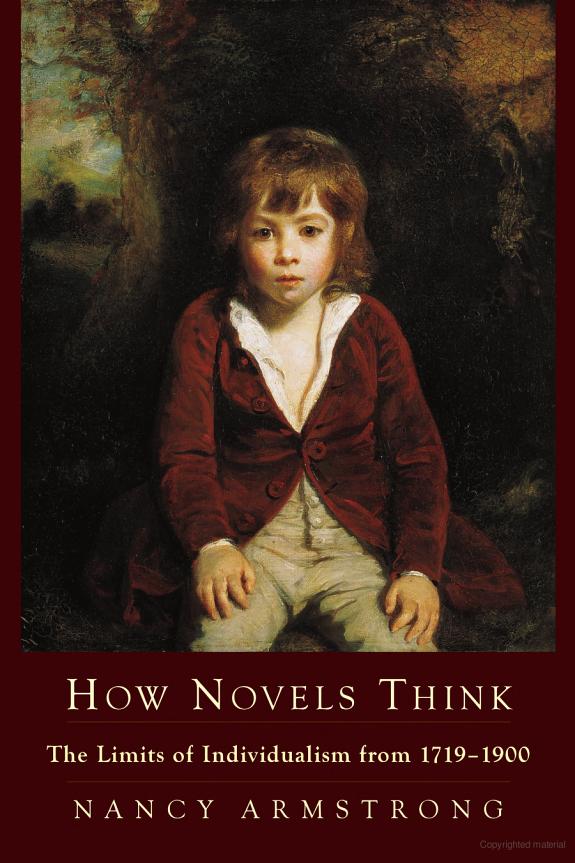
How Novels Think
The Limits of Individualism from 1719-1900
by Nancy Armstrong
224 pages· 2006· ISBN 9780231503877
About
During the eighteenth century, novels by Daniel Defoe, Samuel Richardson, and Jane Austen offered their readers unforgettable, one-of-a-kind protagonists who appeared to overcome the limits of their social positions. This kind of individual did not reflect the authors and readers but endowed both with distinctively modern identities. In the decades following the revolutions in British North America and in France, novels began to question the fantasy of a self-made individual who could not rest until he or she arrived at a better social position. By the early nineteenth century, individualism had consequently become a problem in its own right. Instead of such plucky protagonists as Defoe's Robinson Crusoe and Moll Flanders, Richardson's Pamela Andrews, and Austen's Elizabeth Bennet, we find novels by Sir Walter Scott and Mary Shelley repackaging individualism in monstrous forms that threaten British society with collapse. Victorian novels by Emily Bronte, Charles Dickens, George Eliot, and Thomas Hardy assumed that every man harbors an inner savage, just as every woman harbors an inner whore. The trick in becoming an individual was to transform competitive instinct and seductive power into acceptable forms of masculinity and femininity. The high mortality rate of Victorian heroines testifies to the difficulty of negotiating the passage from savage to civilized. While a novel like The Strange Case of Dr. Jekyll and Mr. Hyde gives up on the effort to contain these contradictory aspects of individualism within one body, Dracula carries the process of disintegration one step further by pitting the modern individual against a species capable of taking over individual desire itself.
Discuss How Novels Think with other readers
Join or start a book club for How Novels Think on Readfeed. Live chat, shared reading progress, and AI discussion questions — free to get started.
Frequently asked questions
How do I join a book club for How Novels Think?
Sign up free on Readfeed, then browse public clubs or start your own club with How Novels Think as the current read. Invite friends with a share link and discuss together with live chat and AI discussion questions.
Can I discuss How Novels Think with other readers online?
Yes. Readfeed book clubs let you chat live, share progress, and join discussions about How Novels Think with readers worldwide — whether your club is virtual, in-person, or hybrid.
Is Readfeed free?
Yes. Creating an account and joining book clubs is free. Sign up to find readers who love the same books and start discussing today.