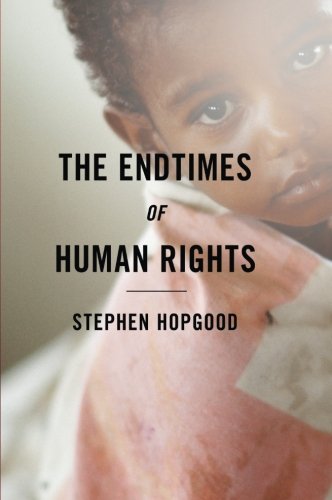
The Endtimes of Human Rights
by Stephen Hopgood
272 pages· 2015· ISBN 9781501700668
About
"We are living through the endtimes of the civilizing mission. The ineffectual International Criminal Court and its disastrous first prosecutor, Luis Moreno-Ocampo, along with the failure in Syria of the Responsibility to Protect are the latest pieces of evidence not of transient misfortunes but of fatal structural defects in international humanism. Whether it is the increase in deadly attacks on aid workers, the torture and 'disappearing' of al-Qaeda suspects by American officials, the flouting of international law by states such as Sri Lanka and Sudan, or the shambles of the Khmer Rouge tribunal in Phnom Penh, the prospect of one world under secular human rights law is receding. What seemed like a dawn is in fact a sunset. The foundations of universal liberal norms and global governance are crumbling."—from The Endtimes of Human Rights In a book that is at once passionate and provocative, Stephen Hopgood argues, against the conventional wisdom, that the idea of universal human rights has become not only ill adapted to current realities but also overambitious and unresponsive. A shift in the global balance of power away from the United States further undermines the foundations on which the global human rights regime is based. American decline exposes the contradictions, hypocrisies and weaknesses behind the attempt to enforce this regime around the world and opens the way for resurgent religious and sovereign actors to challenge human rights. Historically, Hopgood writes, universal humanist norms inspired a sense of secular religiosity among the new middle classes of a rapidly modernizing Europe. Human rights were the product of a particular worldview (Western European and Christian) and specific historical moments (humanitarianism in the nineteenth century, the aftermath of the Holocaust). They were an antidote to a troubling contradiction—the coexistence of a belief in progress with horrifying violence and growing inequality. The obsolescence of that founding purpose in the modern globalized world has, Hopgood asserts, transformed the institutions created to perform it, such as the International Committee of the Red Cross and recently the International Criminal Court, into self-perpetuating structures of intermittent power and authority that mask their lack of democratic legitimacy and systematic ineffectiveness. At their best, they provide relief in extraordinary situations of great distress; otherwise they are serving up a mixture of false hope and unaccountability sustained by “human rights” as a global brand. The Endtimes of Human Rights is sure to be controversial. Hopgood makes a plea for a new understanding of where hope lies for human rights, a plea that mourns the promise but rejects the reality of universalism in favor of a less predictable encounter with the diverse realities of today’s multipolar world.
Discuss The Endtimes of Human Rights with other readers
Join or start a book club for The Endtimes of Human Rights on Readfeed. Live chat, shared reading progress, and AI discussion questions — free to get started.
Frequently asked questions
How do I join a book club for The Endtimes of Human Rights?
Sign up free on Readfeed, then browse public clubs or start your own club with The Endtimes of Human Rights as the current read. Invite friends with a share link and discuss together with live chat and AI discussion questions.
Can I discuss The Endtimes of Human Rights with other readers online?
Yes. Readfeed book clubs let you chat live, share progress, and join discussions about The Endtimes of Human Rights with readers worldwide — whether your club is virtual, in-person, or hybrid.
Is Readfeed free?
Yes. Creating an account and joining book clubs is free. Sign up to find readers who love the same books and start discussing today.