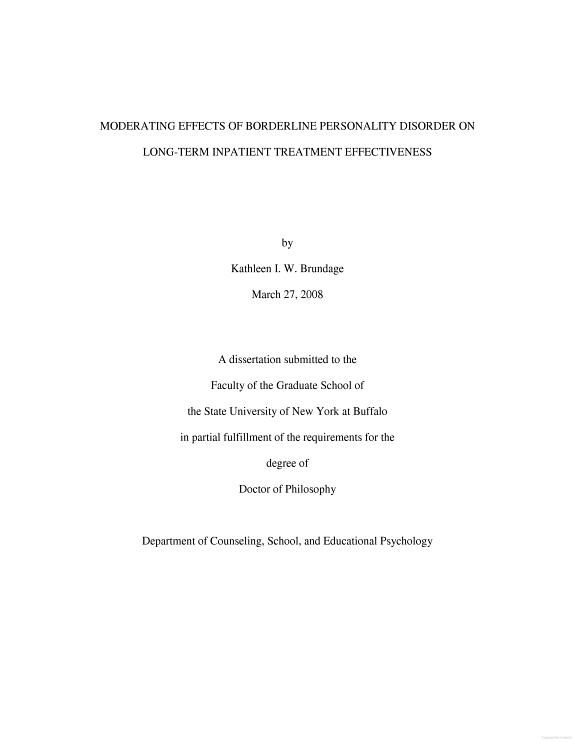
Moderating Effects of Borderline Personality Disorder on Long-term Inpatient Treatment Effectiveness

Moderating Effects of Borderline Personality Disorder on Long-term Inpatient Treatment Effectiveness

109 pages· 2008· ISBN 9780549736523
About
Borderline personality disorder is among the most researched personality disorders because of the severity and chronicity of its symptoms and associated features. The costs of borderline personality disorder are immense, in terms of healthcare utilization and human suffering. Studies of outpatient populations show promise for treatments that can significantly improve prognosis for individuals with this disorder, but little research has demonstrated efficacy in inpatient settings. Further, there are no known studies addressing the treatment needs of those patients with borderline personality disorder who require long-term psychiatric hospitalization. The current study fills a research gap by describing the unique characteristics of the population of persons with borderline personality disorder who utilize long-term inpatient care and examining their general treatment outcomes as compared with other patients in that setting. A retrospective evaluation of the effectiveness of naturalistic long-term inpatient treatment is presented. Results demonstrate that individuals with borderline personality disorder who are admitted for long-term psychiatric care present a significantly different clinical picture from comparison patients undergoing similar treatment. They are younger, more likely to be diagnosed with mood rather than psychotic disorders, and present with more potentially lethal symptoms than other long-term hospital patients. Some demographic differences and differences in level of aftercare were also found. Hypotheses that patients with BPD would have poorer response to long-term inpatient treatment, as evidenced by patterns of service utilization, were partially supported. Compared to other patients, those with BPD have similar lengths of hospital stay and experience a similar number of hospital admissions over their lifetime, but they spend less time out of the hospital between admissions. Treatment gains appear to be less durable for this group and ultimately do not appear to affect symptoms that precipitate hospitalization. Limitations of this study and of research in this setting in general are discussed along with directions for future research. Results are examined in terms of clinical implications for working with this population.

Discuss Moderating Effects of Borderline Personality Disorder on Long-term Inpatient Treatment Effectiveness with other readers

Join or start a book club for Moderating Effects of Borderline Personality Disorder on Long-term Inpatient Treatment Effectiveness on Readfeed. Live chat, shared reading progress, and AI discussion questions — free to get started.

Frequently asked questions

How do I join a book club for Moderating Effects of Borderline Personality Disorder on Long-term Inpatient Treatment Effectiveness?

Sign up free on Readfeed, then browse public clubs or start your own club with Moderating Effects of Borderline Personality Disorder on Long-term Inpatient Treatment Effectiveness as the current read. Invite friends with a share link and discuss together with live chat and AI discussion questions.

Can I discuss Moderating Effects of Borderline Personality Disorder on Long-term Inpatient Treatment Effectiveness with other readers online?

Yes. Readfeed book clubs let you chat live, share progress, and join discussions about Moderating Effects of Borderline Personality Disorder on Long-term Inpatient Treatment Effectiveness with readers worldwide — whether your club is virtual, in-person, or hybrid.

Is Readfeed free?

Yes. Creating an account and joining book clubs is free. Sign up to find readers who love the same books and start discussing today.