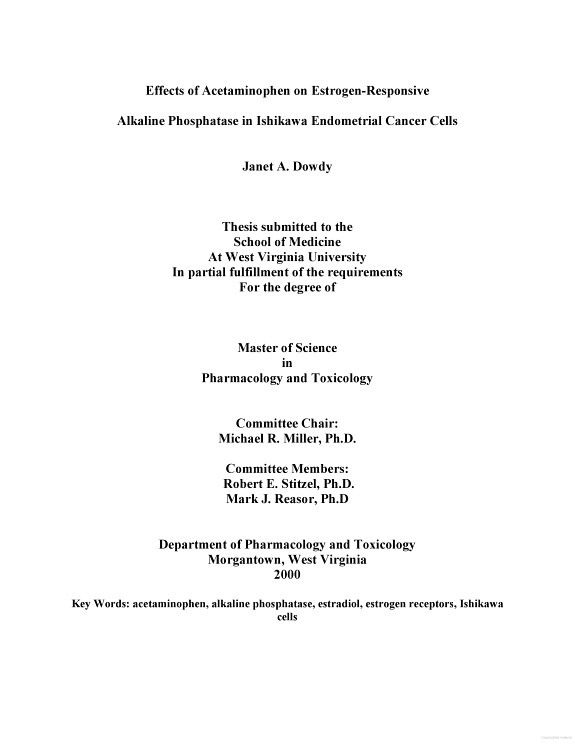
Effects of Acetaminophen on Estrogen-responsive Alkaline Phosphatase in Ishikawa Endometrial Cancer Cells

Effects of Acetaminophen on Estrogen-responsive Alkaline Phosphatase in Ishikawa Endometrial Cancer Cells

86 pages· 2000· ISBN 9780549725664
About
This study examines the effect of acetaminophen (APAP) on the estrogen-responsive gene alkaline phosphatase in Ishikawa endometrial cancer cells. Basal levels of alkaline phosphatase activity were significantly inhibited in cells treated with 0.03, 0.1, 0.3 and 1mM APAP compared to control. Alkaline phosphatase activity induced with 1nM estradiol was significantly inhibited in a concentration dependent manner by 0.0.1, 0.3 and 1mM APAP. APAP did not directly inhibit the activity of alkaline phosphatase at any of the concentrations tested. Increasing estradiol concentrations (0.01, 0.1 and 1nM) did not alter the level of inhibition of alkaline phosphatase activity by 0.1, 0.3 or 1mM APAP. This is in agreement with other studies, which have concluded that APAP does not compete with estradiol for binding at the estrogen receptor (Harnagea-Theophilus a et al., 1999; Isenhower et al., 1986; Miller et al., 1999). Protein concentrations were significantly decreased in Ishikawa cells with 0.3 and 1mM APAP alone or in the presence of 0.01, 0.1 to 1nM estradiol. Inhibition of alkaline phosphatase activity by high levels (0.3 and 1mM) of APAP may be in part due to toxic effects of APAP as determined by LDH release. Fluorescent microscopy using calcein staining techniques show that Ishikawa cells treated with 1nM E2+0.3mM APAP are visibility misshapen; cells treated with 1nM E2+1mM APAP are no longer attached to the plate indicating toxicity. The final part of this study looked at the interaction between antiestrogen-4-hydroxy tamoxifen (OHT) and APAP on alkaline phosphatase activity in Ishikawa cells. While OHT inhibited alkaline phosphatase activity ∼50 percent in estradiol-induced cells, addition of 0.03-1mM APAP increased inhibition significantly in a concentration dependent manner. Results of this study indicate that APAP decreases estrogen-responsive alkaline phosphatase activity in Ishikawa cells in vitro, and that this inhibition is not attributed to direct inhibition of enzyme activity.

Discuss Effects of Acetaminophen on Estrogen-responsive Alkaline Phosphatase in Ishikawa Endometrial Cancer Cells with other readers

Join or start a book club for Effects of Acetaminophen on Estrogen-responsive Alkaline Phosphatase in Ishikawa Endometrial Cancer Cells on Readfeed. Live chat, shared reading progress, and AI discussion questions — free to get started.

Frequently asked questions

How do I join a book club for Effects of Acetaminophen on Estrogen-responsive Alkaline Phosphatase in Ishikawa Endometrial Cancer Cells?

Sign up free on Readfeed, then browse public clubs or start your own club with Effects of Acetaminophen on Estrogen-responsive Alkaline Phosphatase in Ishikawa Endometrial Cancer Cells as the current read. Invite friends with a share link and discuss together with live chat and AI discussion questions.

Can I discuss Effects of Acetaminophen on Estrogen-responsive Alkaline Phosphatase in Ishikawa Endometrial Cancer Cells with other readers online?

Yes. Readfeed book clubs let you chat live, share progress, and join discussions about Effects of Acetaminophen on Estrogen-responsive Alkaline Phosphatase in Ishikawa Endometrial Cancer Cells with readers worldwide — whether your club is virtual, in-person, or hybrid.

Is Readfeed free?

Yes. Creating an account and joining book clubs is free. Sign up to find readers who love the same books and start discussing today.