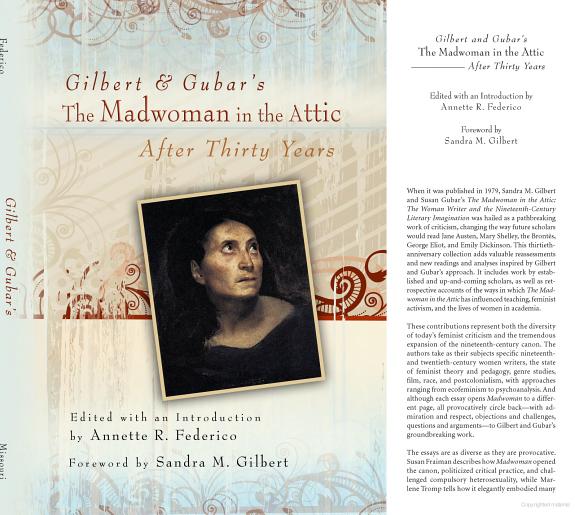
Gilbert and Gubar's The Madwoman in the Attic after Thirty Years

Gilbert and Gubar's The Madwoman in the Attic after Thirty Years

by Annette R. Federico

328 pages· 2011· ISBN 9780826272096
About
When it was published in 1979, Sandra M. Gilbert and Susan Gubar's The Madwoman in the Attic: The Woman Writer and the Nineteenth-Century Literary Imaginationwas hailed as a pathbreaking work of criticism, changing the way future scholars would read Jane Austen, Mary Shelley, the Brontës, George Eliot, and Emily Dickinson. This thirtieth-anniversary collection adds both valuable reassessments and new readings and analyses inspired by Gilbert and Gubar’s approach. It includes work by established and up-and-coming scholars, as well as retrospective accounts of the ways in which The Madwoman in the Attic has influenced teaching, feminist activism, and the lives of women in academia. These contributions represent both the diversity of today’s feminist criticism and the tremendous expansion of the nineteenth-century canon. The authors take as their subjects specific nineteenth- and twentieth-century women writers, the state of feminist theory and pedagogy, genre studies, film, race, and postcolonialism, with approaches ranging from ecofeminism to psychoanalysis. And although each essay opens Madwoman to a different page, all provocatively circle back—with admiration and respect, objections and challenges, questions and arguments—to Gilbert and Gubar's groundbreaking work. The essays are as diverse as they are provocative. Susan Fraiman describes how Madwoman opened the canon, politicized critical practice, and challenged compulsory heterosexuality, while Marlene Tromp tells how it elegantly embodied many concerns central to second-wave feminism. Other chapters consider Madwoman’s impact on Milton studies, on cinematic adaptations of Wuthering Heights, and on reassessments of Ann Radcliffe as one of the book’s suppressed foremothers. In the thirty years since its publication, The Madwoman in the Attic has potently informed literary criticism of women’s writing: its strategic analyses of canonical works and its insights into the interconnections between social environment and human creativity have been absorbed by contemporary critical practices. These essays constitute substantive interventions into established debates and ongoing questions among scholars concerned with defining third-wave feminism, showing that, as a feminist symbol, the raging madwoman still has the power to disrupt conventional ideas about gender, myth, sexuality, and the literary imagination.

Discuss Gilbert and Gubar's The Madwoman in the Attic after Thirty Years with other readers

Join or start a book club for Gilbert and Gubar's The Madwoman in the Attic after Thirty Years on Readfeed. Live chat, shared reading progress, and AI discussion questions — free to get started.

Frequently asked questions

How do I join a book club for Gilbert and Gubar's The Madwoman in the Attic after Thirty Years?

Sign up free on Readfeed, then browse public clubs or start your own club with Gilbert and Gubar's The Madwoman in the Attic after Thirty Years as the current read. Invite friends with a share link and discuss together with live chat and AI discussion questions.

Can I discuss Gilbert and Gubar's The Madwoman in the Attic after Thirty Years with other readers online?

Yes. Readfeed book clubs let you chat live, share progress, and join discussions about Gilbert and Gubar's The Madwoman in the Attic after Thirty Years with readers worldwide — whether your club is virtual, in-person, or hybrid.

Is Readfeed free?

Yes. Creating an account and joining book clubs is free. Sign up to find readers who love the same books and start discussing today.