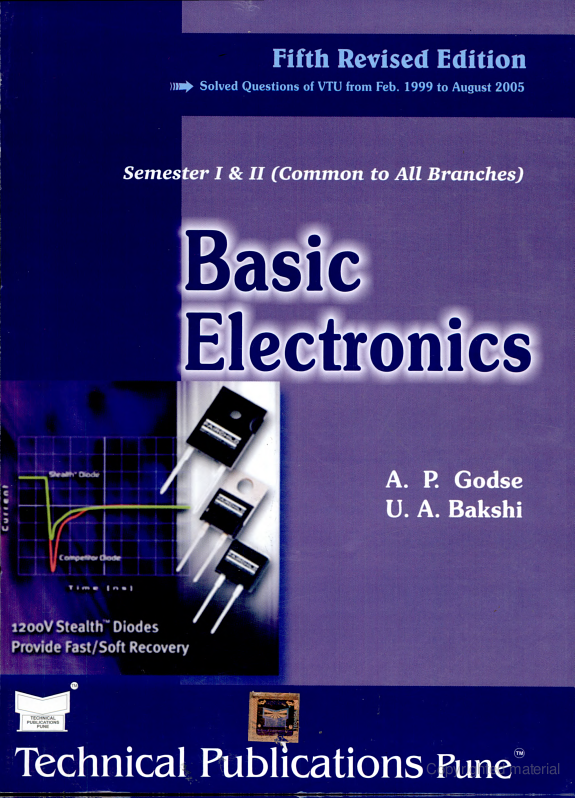
Basic Electronics
by U.A.Bakshi A.P.Godse
606 pages· 2005· ISBN 9788189411268
About
Conduction in SemiconductorsElectrons and holes in an intrinsic semiconductor, conductivity of a semiconductor, carrier concentrations in an intrinsic semiconductor, donor and acceptor impurities, charge densities in a semiconductor. Fermi level in a semiconductor having impurities, diffusion, carrier life time, Hall effect.Semiconductor-Diode CharacteristicsQualitative theory of a PN junction, PN junction as a diode, volt-ampere characteristics, temperature dependence of PN characteristics, half wave and full wave rectifiers, other full wave circuits, ripple factor, capacitor filter; Zener diode-characterisitcs, zener and avalanche breakdown, zener regulated power supply.Transistor CharacteristicsJunction transistor, transistor current components, transistor as an amplifier, common-base configuration, common-emitter configuration, CE cut-off region, CE saturation region, large-signal, DC and small-signal CE values of current gain, operating point, bias stabilization, cascading transistor amplifiers, decibel; classification of amplifiers, distortion in amplifiers, frequency response of an amplifier, RC coupled amplifier.Theory of Sinusoidal OscillatorsConcept of feedback, sinusoidal oscillators, working of RC phase shift, Colpitt's and Hartely's oscillator using BJT expressions for frequency of oscillation (no derivation), crystal oscillator.Operational Amplifiers (Op-Amp)Ideal Op-Amp, inverting and non-inverting Op-Amp, need for Op-Amp, Op-Amp characteristics, Op-Amp applications, voltage follower, addition and subtraction using Op-Amp circuits. Op-Amp integrating and differentiating circuits.Communication SystemsBasic block diagram of communication systems modulation, Amplitude Modulation, frequency spectrum, power relations, Phase and Frequency Modulation, frequency spectrum, comparison of AM and FM, radio telegraphy, radio telephony, super heterodyne receivers.Digital ElectronicsDigital logic-Binary numbers, number base conversion, Octal and hexadecimal numbers, complements, Binary addition and subtraction using One's and Two's complements, addition and subtraction in other number system, fractional numbers and BCD numbers. Binary logic, symbols, basic theorems and properties of Boolean Algebra, De-Morgan's theorem, AND, OR logic gate realisation using diodes, NOT gate using transistor, Diode Transistor Logic (DTL) Resistance Transistor Logic (RTL), Direct Coupled Transistor Logic (DCTL), Current Mode Logic (CML), and Transistor-Transistor Logic (TTL), symbols used for NOT, OR, AND, NAND, XOR gates and their truth tables, Boolean functions, half adder, full adder and parallel binary adder, introduction to sequential logic circuits, working of an R-S flip-flop (transistor version, NAND/NOR version)Cathode Ray Oscilloscope (CRO)Basic block diagram, use of CRO for measurement of amplitude, frequency and phase.
Discuss Basic Electronics with other readers
Join or start a book club for Basic Electronics on Readfeed. Live chat, shared reading progress, and AI discussion questions — free to get started.
Frequently asked questions
How do I join a book club for Basic Electronics?
Sign up free on Readfeed, then browse public clubs or start your own club with Basic Electronics as the current read. Invite friends with a share link and discuss together with live chat and AI discussion questions.
Can I discuss Basic Electronics with other readers online?
Yes. Readfeed book clubs let you chat live, share progress, and join discussions about Basic Electronics with readers worldwide — whether your club is virtual, in-person, or hybrid.
Is Readfeed free?
Yes. Creating an account and joining book clubs is free. Sign up to find readers who love the same books and start discussing today.