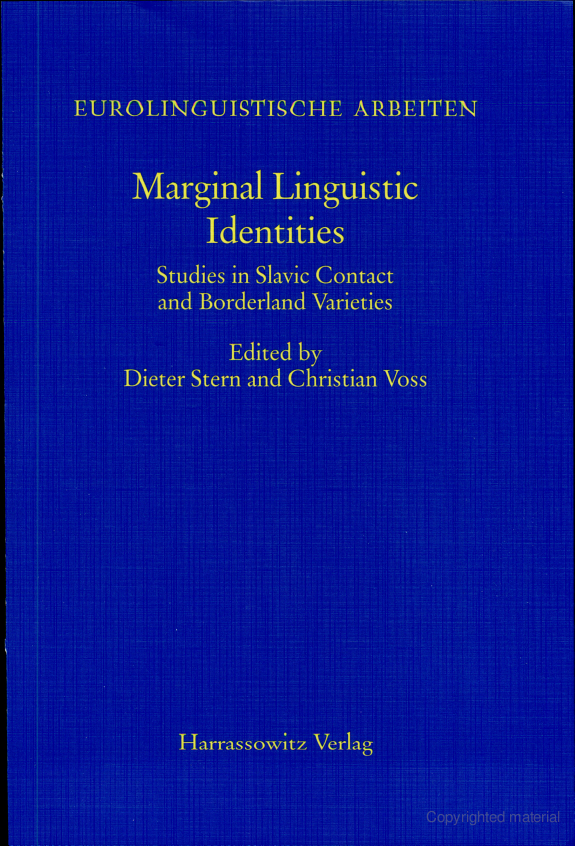
Marginal Linguistic Identities

Marginal Linguistic Identities

Studies in Slavic Contact and Borderland Varieties

by Dieter Hubert Stern, Dieter Stern, Christian Voss

274 pages· 2006· ISBN 9783447053549
About
The present conference volume is an attempt to extend the scope of Eastern European linguistics by bringing together contributions from the fields of sociolinguistics and social anthropology hitherto neglected in the study of Eastern European languages. The collection of papers focusses primarily on cultural and linguistic hybridity in contexts of marginalization. Special attention is given to the language-identity nexus. All analyses are based on field research covering the spectrum from largescale questionnaire elicitation to participant observation. This reflects the editors' concern and hope for a renewed appreciation of field work by Slavic scholars. The volume is structured thematically, dealing withas diverse topics as cultural hybridity, linguistic identity in borderland communities, language death and genesis, code-mixing, as well as dialect shift under conditions of sociopolitical upheaval. Among the languages treated are Kashubian, Banat Bul-garian, Aegean Macedonian, Slovene, non-standard and contact varieties of Russian (Karelian-Russian, Old settlers' Russian, Russian lexifier pidgins and Russian foreigner talk), mixed lects (Surzhyk and Trasianka), and standard-dialect-continua in Ex-Yugoslavia.

Discuss Marginal Linguistic Identities with other readers

Join or start a book club for Marginal Linguistic Identities on Readfeed. Live chat, shared reading progress, and AI discussion questions — free to get started.

Frequently asked questions

How do I join a book club for Marginal Linguistic Identities?

Sign up free on Readfeed, then browse public clubs or start your own club with Marginal Linguistic Identities as the current read. Invite friends with a share link and discuss together with live chat and AI discussion questions.

Can I discuss Marginal Linguistic Identities with other readers online?

Yes. Readfeed book clubs let you chat live, share progress, and join discussions about Marginal Linguistic Identities with readers worldwide — whether your club is virtual, in-person, or hybrid.

Is Readfeed free?

Yes. Creating an account and joining book clubs is free. Sign up to find readers who love the same books and start discussing today.