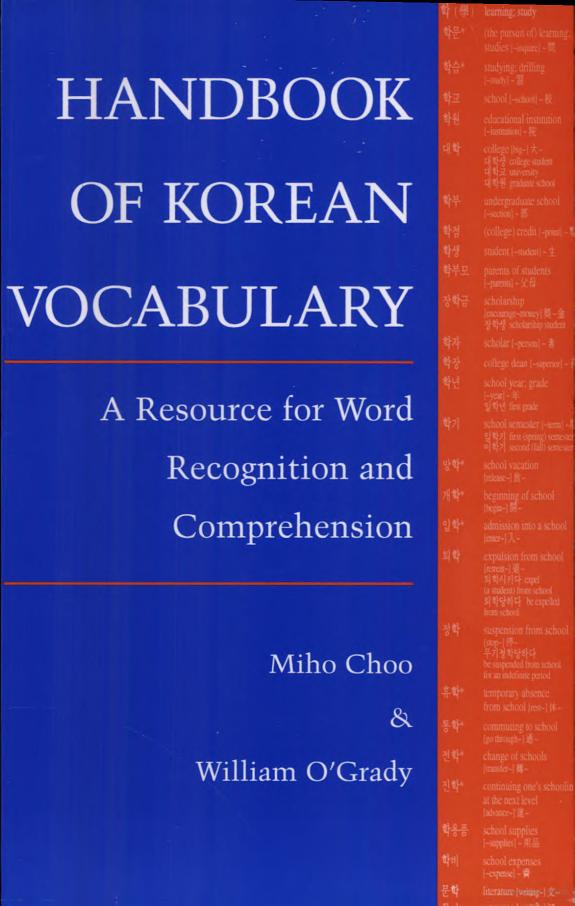
Handbook of Korean Vocabulary

Handbook of Korean Vocabulary

An Approach to Word Recognition and Comprehension

by Miho Choo, William D. O'Grady, William O'Grady

387 pages· 1996· ISBN 9780824818159
About
Vocabulary learning is the single most important component of second-language acquisition. In cases where the second language is unrelated to the learner's native tongue, this task presents special challenges because there are typically few clues in a word's form to assist in learning and remembering its meaning. The Handbook of Korean Vocabulary offers a solution to this problem for students of Korean. The Handbook is the first ever "root dictionary" of Korean designed for second-language learners. Useful for students at all levels, it contains more than 1,500 vocabulary lists consisting of words built from a shared root. These lists offer a unique and efficient way for students to acquire new words. Upon encountering a word, students can consult the lists for its component roots and discover many other semantically related words built from the same elements. The Handbook consists of two sections, the first presenting roots of Chinese origin and the second containing native Korean roots. Within each section, lists are arranged with respect to each other in alphabetic order as determined by the Korean spelling of the root morpheme. Each list begins with the relevant root written in Korean script together with its Chinese character (if there is one) and its English translation. As indicated in the following example, the entries for individual words within a list include information about each item's colloquial interpretation, the literal meaning of its component parts, and (for the sake of advanced students and those who know Japanese or Chinese) the Chinese characters used to write it. An introduction provides an overview of Korean vocabulary and detailed instructions on how to use the word lists. A pronunciation guide outlines the major principles determining the pronunciation of compounds and other multipart words in Korean. The Handbook will be of value not only to teachers and students of the Korean language, whose number is growing each year, but to native speakers of Korean who wish to use the word structure of their native language as a starting point for the study of English vocabulary.

Discuss Handbook of Korean Vocabulary with other readers

Join or start a book club for Handbook of Korean Vocabulary on Readfeed. Live chat, shared reading progress, and AI discussion questions — free to get started.

Frequently asked questions

How do I join a book club for Handbook of Korean Vocabulary?

Sign up free on Readfeed, then browse public clubs or start your own club with Handbook of Korean Vocabulary as the current read. Invite friends with a share link and discuss together with live chat and AI discussion questions.

Can I discuss Handbook of Korean Vocabulary with other readers online?

Yes. Readfeed book clubs let you chat live, share progress, and join discussions about Handbook of Korean Vocabulary with readers worldwide — whether your club is virtual, in-person, or hybrid.

Is Readfeed free?

Yes. Creating an account and joining book clubs is free. Sign up to find readers who love the same books and start discussing today.