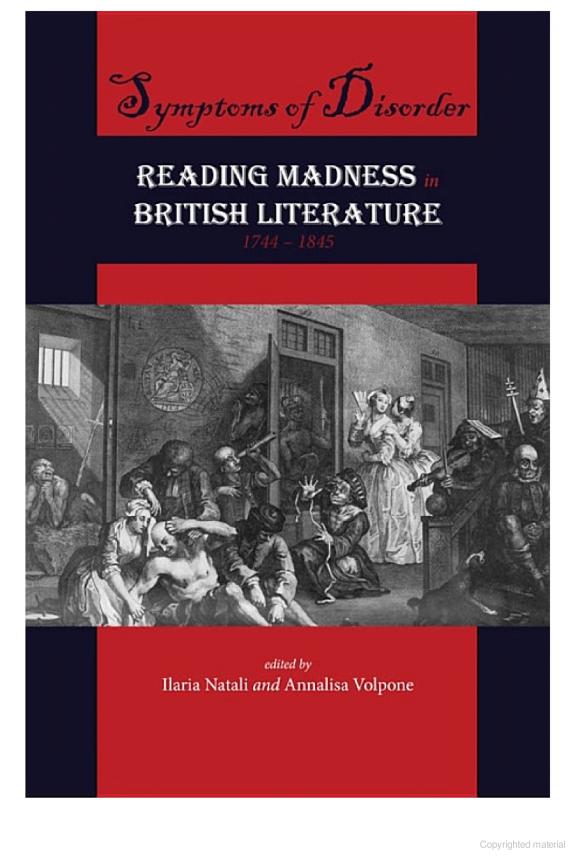
The stylistic and cultural discourse concerning the narratives of mental disorder is the main focus of Symptoms of Disorder: Reading Madness in British Literature 1744-1845. This collection offers new insights into the representation of madness in British literature between two landmark dates for the social, philosophical and medical history of mental deviance: 1744 and 1845. In 1744, the Vagrancy Act first mentions 'lunatics' as a specific category, which is itself a social 'symptom' of an emerging need for isolation and confinement of the insane. A more sophisticated and attentive care of the 'fool' is testified only by the 1845 Lunatic Asylums Act, which established specific processes safeguarding against the wrongful detention of patients in public and private facilities. In stressing for the first time the momentous change the notion of madness underwent between these years, this book provides a fresh and absolutely unique perspective on some of the major works connected with mental disorder. The chronological boundaries also provide the collection with a definite and unifying frame, which comprises social, cultural, legal and medical aspects of madness as an historical phenomenon. It is within this frame that the eight essays composing the body of the book discuss how madness is recounted, or even experienced, by authors such as Christopher Smart and William Cowper, William Blake, Samuel Taylor Coleridge, John Thomas Perceval, Samuel Richardson, Charlotte Lennox, Eliza Haywood, and Alfred Tennyson. Symptoms of Disorder draws a wide-ranging map of different representations of madness and their historic functioning between the 18th and 19th centuries. The organizational principle of this collection is a double perspective, which allows to suitably articulate the characterizations of insanity into themes and genres. Reflecting the two main ways in which literary madness can be employed as a critical device in literature, the chapters are grouped into theme-oriented and writer-oriented analyses. Other collections dealing with literature and madness have already coped, to a certain degree, with works that represent insane characters and authors who adopt 'deviant' voices as a fictional or rhetoric expedient. Fewer studies of the same kind, instead, have offered a more comprehensive picture by also looking at the alleged insanity of the writer, and at those linguistic, stylistic and semantic elements which at some stage were commonly believed to be an expression of insanity. This is one of the first studies which addresses the representation of madness from both these intertwined perspectives. See www.cambriapress.com/books/9781604979251.cfm for more information.