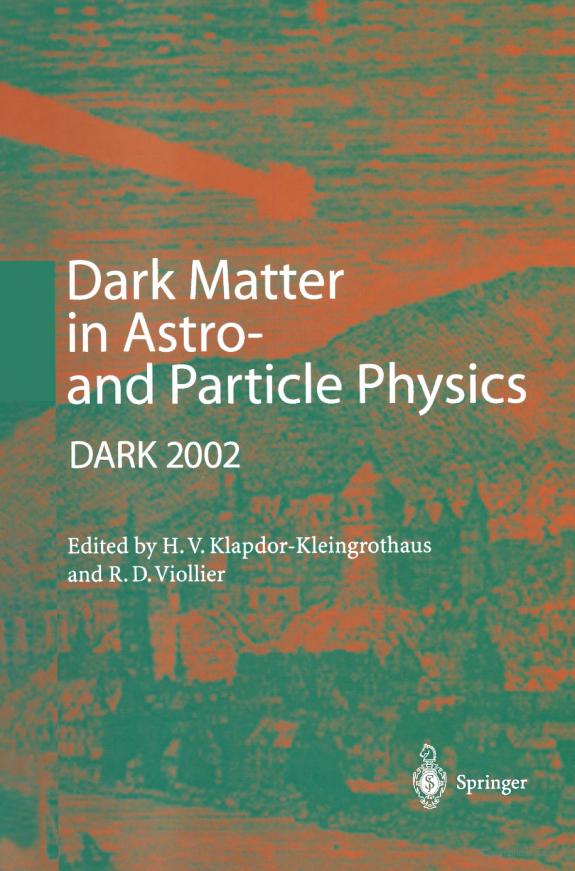
Dark Matter in Astro- and Particle Physics

Dark Matter in Astro- and Particle Physics

Proceedings of the International Conference DARK 2002, Cape Town, South Africa, 4–9 February 2002

by Hans-Volker Klapdor-Kleingrothaus, Raoul D. Viollier

663 pages· 2012· ISBN 9783642557392
About
The Fourth HEIDELBERG International Conference on Dark Matter in Astro and Particle Physics, DARK2002, was held in Cape Town, South Africa, in the period 4-9 February 2002. This majestic natural area was the site of the first conference of this series (hosted since 1996 in Heidelberg) to be held outside of Germany. Dark Matter has become one of the most exciting and central fields of as trophysics, particle physics and cosmology. The conference covered, as usual for this series, a large range of topics, theoretical and experimental. Topics included Astronomical Evidence for Dark Matter, the Cosmic Microwave Background, Supersymmetry, Inflation and Dark Energy, Structure Formation, Hot and Cold Dark Matter, and Ultrahigh Energy Cosmic Rays all of which were represented by experts in the field. It was very nice to see again many of our 'old' friends in Dark Matter here in South Africa. The organizers were very glad to see, in addition to world experts, the new generation here. Many young participants gave very nice professional talks during the conference. We are grateful to John Ellis for doing an incredible job preparing his excellent summary talk during the sessions. Some special interest and intensive discussions were naturally raised by the first announcement of terrestrial evidence for hot dark matter, obtained from neutrino less double beta decay. This now adds to the evidence for cold dark matter which we have from DAM A for several years already, and which remained unchallenged up to now by other experiments.

Discuss Dark Matter in Astro- and Particle Physics with other readers

Join or start a book club for Dark Matter in Astro- and Particle Physics on Readfeed. Live chat, shared reading progress, and AI discussion questions — free to get started.

Frequently asked questions

How do I join a book club for Dark Matter in Astro- and Particle Physics?

Sign up free on Readfeed, then browse public clubs or start your own club with Dark Matter in Astro- and Particle Physics as the current read. Invite friends with a share link and discuss together with live chat and AI discussion questions.

Can I discuss Dark Matter in Astro- and Particle Physics with other readers online?

Yes. Readfeed book clubs let you chat live, share progress, and join discussions about Dark Matter in Astro- and Particle Physics with readers worldwide — whether your club is virtual, in-person, or hybrid.

Is Readfeed free?

Yes. Creating an account and joining book clubs is free. Sign up to find readers who love the same books and start discussing today.