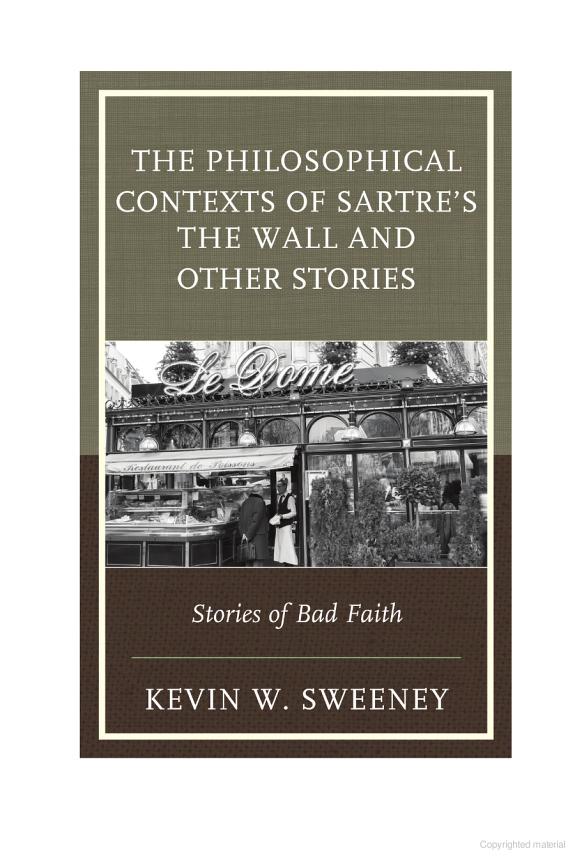
The Philosophical Contexts of Sartre’s The Wall and Other Stories

The Philosophical Contexts of Sartre’s The Wall and Other Stories

Stories of Bad Faith

by Kevin W. Sweeney

156 pages· 2016· ISBN 9781498509374
About
This book presents a philosophical analysis of all five stories in Sartre’s short-story collection. Kevin W. Sweeney's thesis is that each of the five stories has its own philosophical idea or problem that serves as the context for the narrative. Sartre constructs each story as a reply to the philosophical issue in the context and as support for his position on that issue. In the opening story, “The Wall,” Sartre uses the Constant-Kant debate to support his view that the story’s protagonist is responsible for his ally’s death. “The Room” presents in narrative form Sartre’s criticism that the Freudian Censor is acting in bad faith. In “Erostratus,” Sartre opposes Descartes’s claim in his “hats and coats” example that we recognize the humanity of others by using our Reason. In “Intimacy,” Sartre again opposes a Cartesian position, this time the view that our feelings reveal our emotions. Sartre counters that Cartesian view by showing that the two women in the story act in bad faith because they do not distinguish their feelings from their emotions. The last story, “The Childhood of a Leader,” shows how the protagonist acts in bad faith in trying to resolve the question of who he is by appealing to the view that one’s roots in Nature can provide one with a substantial identity. The stories are unified by showing the characters in all five narratives engaged in different acts of bad faith.

Discuss The Philosophical Contexts of Sartre’s The Wall and Other Stories with other readers

Join or start a book club for The Philosophical Contexts of Sartre’s The Wall and Other Stories on Readfeed. Live chat, shared reading progress, and AI discussion questions — free to get started.

Frequently asked questions

How do I join a book club for The Philosophical Contexts of Sartre’s The Wall and Other Stories?

Sign up free on Readfeed, then browse public clubs or start your own club with The Philosophical Contexts of Sartre’s The Wall and Other Stories as the current read. Invite friends with a share link and discuss together with live chat and AI discussion questions.

Can I discuss The Philosophical Contexts of Sartre’s The Wall and Other Stories with other readers online?

Yes. Readfeed book clubs let you chat live, share progress, and join discussions about The Philosophical Contexts of Sartre’s The Wall and Other Stories with readers worldwide — whether your club is virtual, in-person, or hybrid.

Is Readfeed free?

Yes. Creating an account and joining book clubs is free. Sign up to find readers who love the same books and start discussing today.