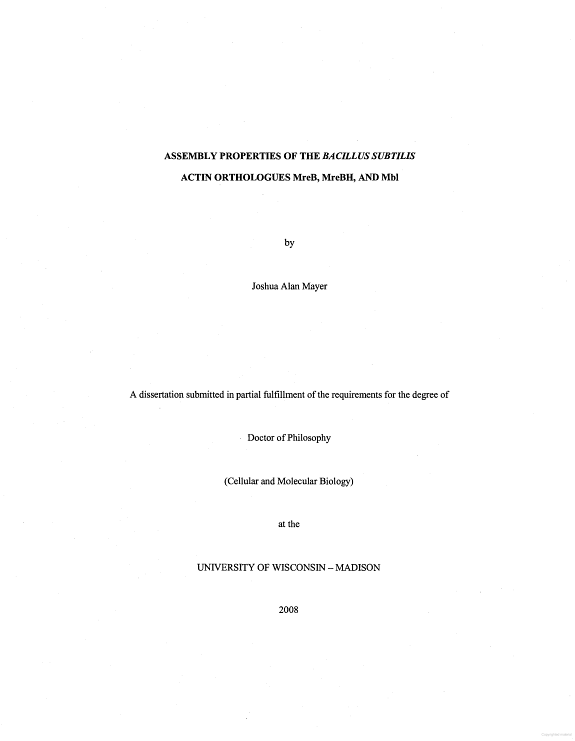
Assembly Properties of the Bacillus Subtilis Actin Orthologues MreB, MreBH, and Mbl

Assembly Properties of the Bacillus Subtilis Actin Orthologues MreB, MreBH, and Mbl

by Joshua Alan Mayer

209 pages· 2008· ISBN 9781109048636
About
MreB is a 36 kDa protein recently identified as a genuine orthologue of eukaryotic actins. Since this landmark discovery, MreB is known to be essential for numerous cellular functions including cell shape determination and regulation of cell wall synthesis, chromosome dynamics including segregation, and determination and maintenance of cell polarity. To further characterize the biochemical properties of MreB polymerization and its interactions with cellular binding partners, I began a course of study to purify the MreB protein from a common laboratory bacterium, Bacillus subtilis, and then utilize this purified protein to confirm binding partners and elucidate the effects of these interactions on the respective molecules. Using recombinant native protein purified through polymerization and depolymerization cycles, I characterized the conditions that regulate monomer to polymer assembly of MreB including dependencies on pH, temperature, and ions. MreB polymerization was observed to be significantly more temperature-dependent and salt sensitive than the previously characterized Thermotoga maritima MreB1. Through the use of varying nucleotides in polymerization and critical concentration experiments, I determined that MreB polymerization is a nucleotide-independent process which contrasts significantly with MreB1 and eukaryotic actins. This purified MreB protein was used to confirm and characterize interactions with numerous potential MreB-binding proteins. Light scattering and cosedimentation assays of polymerization reactions revealed numerous interactions with molecules involve in chromosome dynamics, cell wall synthesis, translation, and the two remaining actin orthologues in B. subtilis, MreBH and Mbl. These interactions likely serve dual purposes of localizing the MreB-binding protein while simultaneously affecting the dynamics of MreB polymerization. Intriguingly, MreBH and Mbl have been proposed to localize in a tripolymer structure with MreB. Toward a more complete understanding of the polymerization properties of three actin orthologues in B. subtilis, I subsequently began a course of experimentation to purify and biochemically characterize MreBH and Mbl. The results present intriguing ramifications for the in vivo activities of each actin orthologue including the relationships among all the monomer and polymer forms of each protein and have profound impacts on the cellular functions of the bacterial actin-like cytoskeleton.

Discuss Assembly Properties of the Bacillus Subtilis Actin Orthologues MreB, MreBH, and Mbl with other readers

Join or start a book club for Assembly Properties of the Bacillus Subtilis Actin Orthologues MreB, MreBH, and Mbl on Readfeed. Live chat, shared reading progress, and AI discussion questions — free to get started.

Frequently asked questions

How do I join a book club for Assembly Properties of the Bacillus Subtilis Actin Orthologues MreB, MreBH, and Mbl?

Sign up free on Readfeed, then browse public clubs or start your own club with Assembly Properties of the Bacillus Subtilis Actin Orthologues MreB, MreBH, and Mbl as the current read. Invite friends with a share link and discuss together with live chat and AI discussion questions.

Can I discuss Assembly Properties of the Bacillus Subtilis Actin Orthologues MreB, MreBH, and Mbl with other readers online?

Yes. Readfeed book clubs let you chat live, share progress, and join discussions about Assembly Properties of the Bacillus Subtilis Actin Orthologues MreB, MreBH, and Mbl with readers worldwide — whether your club is virtual, in-person, or hybrid.

Is Readfeed free?

Yes. Creating an account and joining book clubs is free. Sign up to find readers who love the same books and start discussing today.