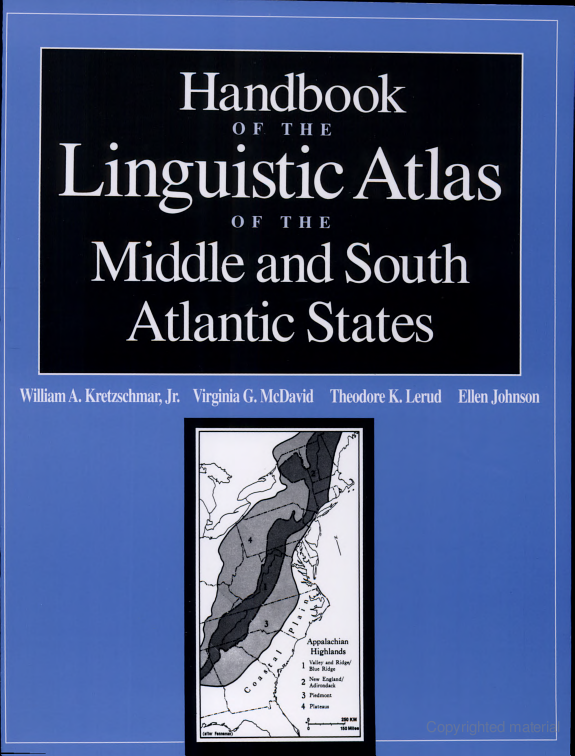
Handbook of the Linguistic Atlas of the Middle and South Atlantic States

Handbook of the Linguistic Atlas of the Middle and South Atlantic States

by William A. Kretzschmar

454 pages· 1993· ISBN 9780226452838
About
Who uses "skeeter hawk," "snake doctor," and "dragonfly" to refer to the same insect? Who says "gum band" instead of "rubber band"? The answers can be found in the Linguistic Atlas of the Middle and South Atlantic States (LAMSAS), the largest single survey of regional and social differences in spoken American English. It covers the region from New York state to northern Florida and from the coastline to the borders of Ohio and Kentucky. Through interviews with nearly twelve hundred people conducted during the 1930s and 1940s, the LAMSAS mapped regional variations in vocabulary, grammar, and pronunciation at a time when population movements were more limited than they are today, thus providing a unique look at the correspondence of language and settlement patterns. This handbook is an essential guide to the LAMSAS project, laying out its history and describing its scope and methodology. In addition, the handbook reveals biographical information about the informants and social histories of the communities in which they lived, including primary settlement areas of the original colonies. Dialectologists will rely on it for understanding the LAMSAS, and historians will find it valuable for its original historical research. Since much of the LAMSAS questionnaire concerns rural terms, the data collected from the interviews can pinpoint such language differences as those between areas of plantation and small-farm agriculture. For example, LAMSAS reveals that two waves of settlement through the Appalachians created two distinct speech types. Settlers coming into Georgia and other parts of the Upper South through the Shenandoah Valley and on to the western side of the mountain range had a Pennsylvania-influenced dialect, and were typically small farmers. Those who settled the Deep South in the rich lowlands and plateaus tended to be plantation farmers from Virginia and the Carolinas who retained the vocabulary and speech patterns of coastal areas. With these revealing findings, the LAMSAS represents a benchmark study of the English language, and this handbook is an indispensable guide to its riches.

Discuss Handbook of the Linguistic Atlas of the Middle and South Atlantic States with other readers

Join or start a book club for Handbook of the Linguistic Atlas of the Middle and South Atlantic States on Readfeed. Live chat, shared reading progress, and AI discussion questions — free to get started.

Frequently asked questions

How do I join a book club for Handbook of the Linguistic Atlas of the Middle and South Atlantic States?

Sign up free on Readfeed, then browse public clubs or start your own club with Handbook of the Linguistic Atlas of the Middle and South Atlantic States as the current read. Invite friends with a share link and discuss together with live chat and AI discussion questions.

Can I discuss Handbook of the Linguistic Atlas of the Middle and South Atlantic States with other readers online?

Yes. Readfeed book clubs let you chat live, share progress, and join discussions about Handbook of the Linguistic Atlas of the Middle and South Atlantic States with readers worldwide — whether your club is virtual, in-person, or hybrid.

Is Readfeed free?

Yes. Creating an account and joining book clubs is free. Sign up to find readers who love the same books and start discussing today.