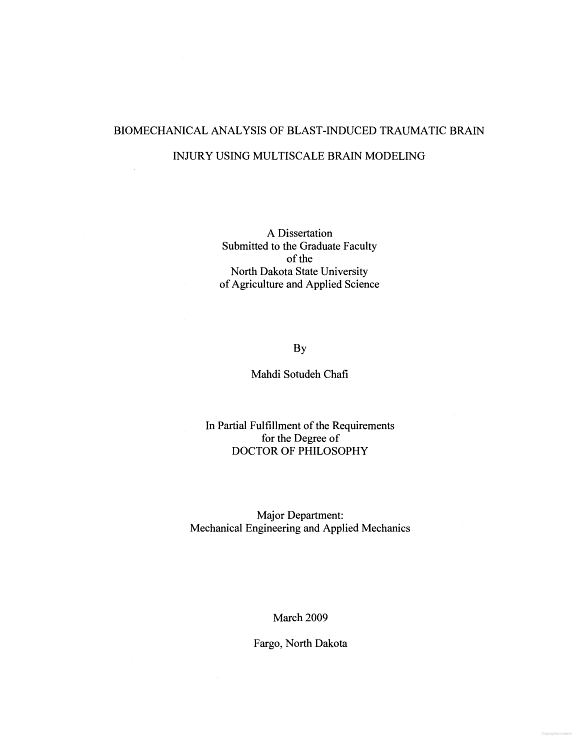
Biomechanical Analysis of Blast-induced Traumatic Brain Injury Using Multiscale Brain Modeling

Biomechanical Analysis of Blast-induced Traumatic Brain Injury Using Multiscale Brain Modeling

204 pages· 2009· ISBN 9781109126587
About
In this thesis, an integrated and mechanized finite element (FE) model is developed for predicting a human brain's primary blast injury (PBI) and for assisting in the design of personal protective human head equipment. Due to the fact that there is no quantitative experimental data on blast-head interactions, several important checkpoints are made before embarking on the blast-brain interaction responses. These checkpoints include: (a) a validated FE human head; (b) a verified free-air blast wave model; and (c) a verified blast-solid interaction model. The developed human head model has the complete anatomical features of the head and the brain. Particular emphasis are given to the brain-skull interface characteristics; the constitutive properties of various components, especially the brain tissue hyper-viscoelastic material behavior; and the level of validation. Prior to blast-head analysis, a flexible and representative air blast model is also developed to simulate the blast environments. With a rolled homogeneous armor (RHA) steel plate embedded into the air blast model, the fluid-structure interaction is examined and validated with the experimental blast studies. The numerical solutions are indicative of the model's potential to predict the free-air blast loading as well as blast-structure interactions under general circumstances. The head model is exposed to different scenarios of blast loading to study the brain responses. The responses (i.e. intracranial pressure, stress and strain) are compared to their respective injury thresholds. Such comparisons examine the applicability of the model and provide insight into the foundations of primary injury under blast loadings. The last section focuses on a multiscale modeling of the brain tissue that incorporates basic micromechanics brain characterization with macroscale brain analysis. An optimization procedure based on genetic algorithms (GAs) is used to identify linear viscoelastic material parameters associated with the axons and extracellular matrix of brain tissue based on the experimental as well as the micromechanical modeling data. New hyperviscoelastic material parameters are extracted for guinea pig brain tissue and human cadaveric brain tissue. Both of these materials are then used in blast modeling and the differences between the responses are shown.

Discuss Biomechanical Analysis of Blast-induced Traumatic Brain Injury Using Multiscale Brain Modeling with other readers

Join or start a book club for Biomechanical Analysis of Blast-induced Traumatic Brain Injury Using Multiscale Brain Modeling on Readfeed. Live chat, shared reading progress, and AI discussion questions — free to get started.

Frequently asked questions

How do I join a book club for Biomechanical Analysis of Blast-induced Traumatic Brain Injury Using Multiscale Brain Modeling?

Sign up free on Readfeed, then browse public clubs or start your own club with Biomechanical Analysis of Blast-induced Traumatic Brain Injury Using Multiscale Brain Modeling as the current read. Invite friends with a share link and discuss together with live chat and AI discussion questions.

Can I discuss Biomechanical Analysis of Blast-induced Traumatic Brain Injury Using Multiscale Brain Modeling with other readers online?

Yes. Readfeed book clubs let you chat live, share progress, and join discussions about Biomechanical Analysis of Blast-induced Traumatic Brain Injury Using Multiscale Brain Modeling with readers worldwide — whether your club is virtual, in-person, or hybrid.

Is Readfeed free?

Yes. Creating an account and joining book clubs is free. Sign up to find readers who love the same books and start discussing today.