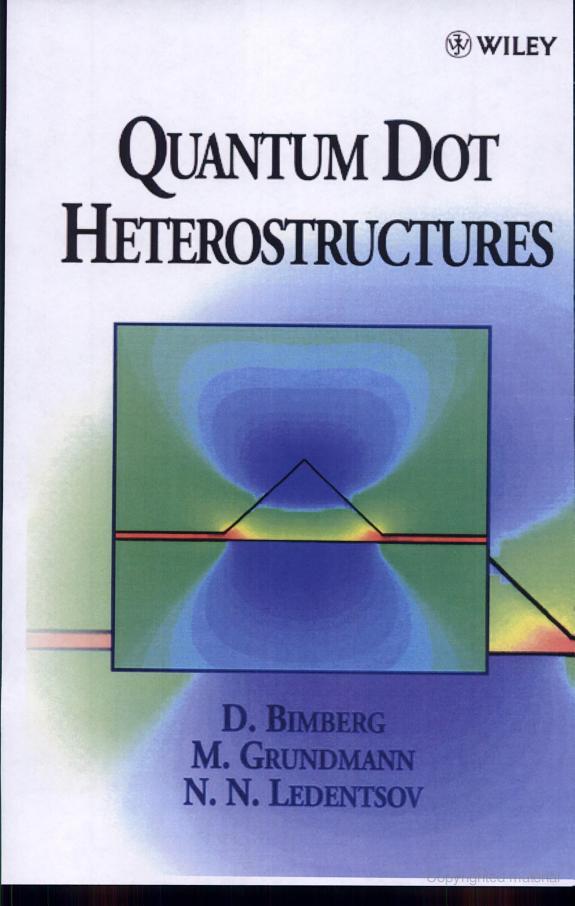
Quantum Dot Heterostructures

Quantum Dot Heterostructures

by Dieter Bimberg, Marius Grundmann, Nikolai N. Ledentsov

328 pages· 1999· ISBN 9780471973881
About
Quantum Dot Heterostructures Dieter Bimberg, Marius Grundmann and Nikolai N. Ledentsov Institute of Solid State Physics, Technische Universität Berlin, Germany Quantum dots are nanometer–size semiconductor structures, and represent one of the most rapidly developing areas of current semiconductor research as increases in the speed and decreases in the size of semiconductor devices become more important. They present the utmost challenge to semiconductor technology, making possible fascinating novel devices. This important new reference book focuses on the key phenomena and principles. Chapter 1 provides a brief account of the history of quantum dots, whilst the second chapter surveys the various fabrication techniques used in the past two decades, and introduces the concept of self–organized growth. This topic is expanded in the following chapter, which presents a broad review of self–organization phenomena at surfaces of crystals. Experimental results on growth of quantum dot structures in many different systems and on their structural characterization are presented in Chapter 4. Basic properties of the dots relate to their geometric structure and chemical composition. Numerical modeling of the electronic and optical properties of real dots is presented in Chapter 5, together with general theoretical considerations on carrier capture, relaxation, recombination and properties of quantum dot lasers. Chapters 6 and 7 summarize experimental results on electronic, optical and electrical properties. The book concludes by disoussing highly topical results on quantum–dot–based photonic devices – mainly quantum dot lasers. Quantum Dot Heterostructures is written by some of the key researchers who have contributed significantly to the development of the field, and have pioneered both the theoretical understanding of quantum dot related phenomena and quantum dot lasers. It is of great interest to graduate and postgraduate students, and to researchers in semiconductor physics and technology and optoelectronics.

Discuss Quantum Dot Heterostructures with other readers

Join or start a book club for Quantum Dot Heterostructures on Readfeed. Live chat, shared reading progress, and AI discussion questions — free to get started.

Frequently asked questions

How do I join a book club for Quantum Dot Heterostructures?

Sign up free on Readfeed, then browse public clubs or start your own club with Quantum Dot Heterostructures as the current read. Invite friends with a share link and discuss together with live chat and AI discussion questions.

Can I discuss Quantum Dot Heterostructures with other readers online?

Yes. Readfeed book clubs let you chat live, share progress, and join discussions about Quantum Dot Heterostructures with readers worldwide — whether your club is virtual, in-person, or hybrid.

Is Readfeed free?

Yes. Creating an account and joining book clubs is free. Sign up to find readers who love the same books and start discussing today.