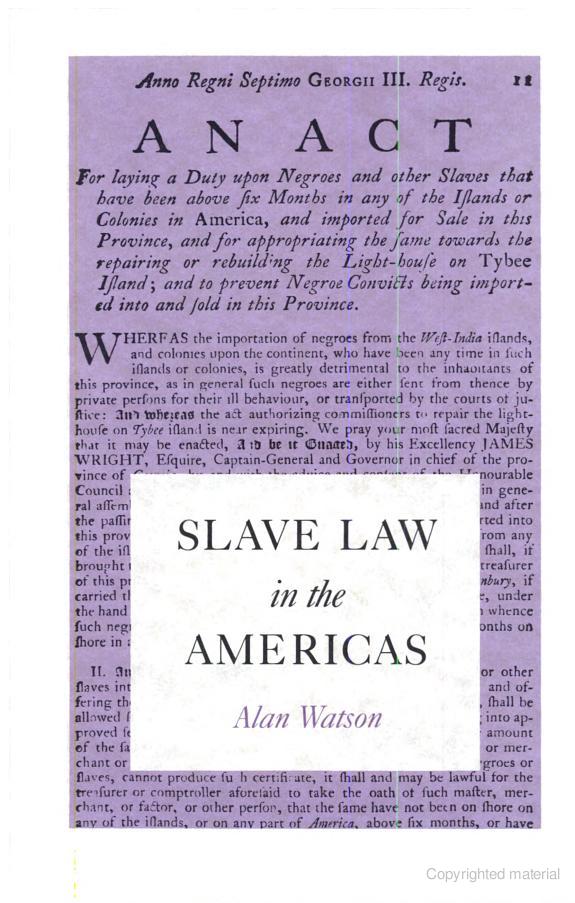
Slave Law in the Americas
by Alan Watson
179 pages· 1989· ISBN 9780820311791
About
In this book, Alan Watson argues that the slave laws of North and South America--the written codes defining the relationship of masters to slaves--reflect not so much the culture and society of the various colonies but the legal traditions of England, Europe, and ancient Rome. A pathbreaking study concerned as much with the nature of comparative law as the specific subject of the law of slavery, Slave Law in the Americas posits an essential distance in the Western legal tradition between the tenets of law and the values of the society they govern. Laws, Watson shows, often are made not by governments or rulers but by jurists as in ancient Rome, law professors as in medieval and continental Europe, and judges as in common law England. Bodies of law, often created without reference to particular social and political ideals, are also often transferred whole cloth from one society to another. Tracing the effects of the reception of Roman law throughout Europe (excluding England) and the Americas, Watson reveals the enormous impact of this legal tradition on subsequent lawmakers operating under utterly dissimilar social and political conditions in the New World. Slave law in the colonies, Watson demonstrates, had much to do with the mother country's relations to Roman law. Spain, Portugal, France, and the United Dutch Provinces, all within the Roman legal tradition, imposed on their colonies slave laws that were private and nonracist in character, laws that interfered little in master-slave relations and provided for the relative ease of manumission and the grant of citizenship to freed slaves. England, however, did not ascribe to Roman law and colonists created rather than received slave law. Public and racist, slave law in the English colonies uniquely reflected local concerns, involving every citizen in the protection and perpetuation of slavery, strictly regulating education, manumission, and citizenship status. "Comparative legal history," Watson writes, "is in its infancy." Presenting the laws of slavery in ancient Rome and in the slaveholding colonies of America, Watson demonstrates how comparative law can elucidate the relationship of law, legal rules, and institutions to the society in which they operate. Investigating not the dynamics of slavery but of slave law, he reveals the working of a legal culture and its peculiar history.
Discuss Slave Law in the Americas with other readers
Join or start a book club for Slave Law in the Americas on Readfeed. Live chat, shared reading progress, and AI discussion questions — free to get started.
Frequently asked questions
How do I join a book club for Slave Law in the Americas?
Sign up free on Readfeed, then browse public clubs or start your own club with Slave Law in the Americas as the current read. Invite friends with a share link and discuss together with live chat and AI discussion questions.
Can I discuss Slave Law in the Americas with other readers online?
Yes. Readfeed book clubs let you chat live, share progress, and join discussions about Slave Law in the Americas with readers worldwide — whether your club is virtual, in-person, or hybrid.
Is Readfeed free?
Yes. Creating an account and joining book clubs is free. Sign up to find readers who love the same books and start discussing today.