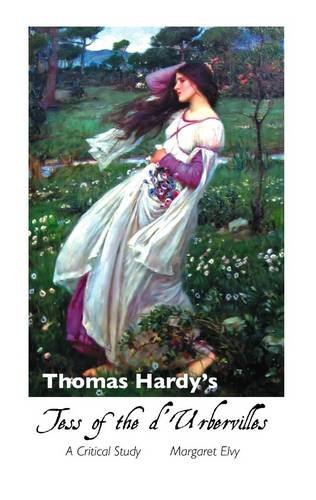
THOMAS HARDY'S TESS OF THE D'URBERVILLES: A CRITICAL STUDY A detailed and incisive analysis of Thomas Hardy's classic 1891 novel, using the latest research in feminism, gay, lesbian and queer theory, and cultural studies. Illustrated (includes images from the magazine serializations of Tess). Bibliogaphy. Notes. This edition has been completely revised. www.crmoon.com Margaret Elvy offers a thorough reappraisal of Thomas Hardy's favourite heroine. Elvy incorporates much of recent Hardy criticism, in which Hardy has been reappraised in the light of materialist, psychoanalytic, gender, poststructuralist and feminist criticism. Tess of the d'Urbervilles is a novel of anger, a text which rages against time, God, industrialization, and social institutions such as marriage, Chrisianity, the Church, law and education. What does Tess Durbeyfield do that is 'wrong'? Thomas Hardy explains in the book: ' s]he had been made to break an accepted social law, but no law known to the environment in which she fancied herself such an anomaly.' Tess is forced, or is led, or falls into a complex situation by circumstances, confusions, innocence (or ignorance), bad communication and desire. She is 'made' to break 'an accepted social law': it is the same with Eustacia Vye in The Return of the Native, and Sue Bridehead in Jude the Obscure. Somehow, their very existence means transgressions will occur. Tess Durbeyfield transgresses society, goes against grain. She (unwittingly perhaps) places herself outside of society and the law. She learns that there are different kinds of laws, different sets of laws for different groups of people. She has to learn about social boundaries, and how to keep inside of limits. As it's a dramatic novel, Tess learns the hard way. She is seen to be transgressive. The education system fails her utterly, her mother and family also fail to protect her. Though she is proud of her education, it fails her utterly. A note in the Life, Hardy's autobiography, is usually cited in relation to Tess of the d'Urbervilles: ' w]hen a married woman who has a lover kills her husband, she does not really wish to kill her husband; she wishes to kill the situation.' The tragedy of Tess of the d'Urbervilles has been seen as a socio-economic destruction (Arnold Kettle); the result of commercial forces, in the Marxist model (Raymond Williams); the decline of the rural order (John Alcorn, Roger Ebbatson, Merryn Williams); the waste of human potential (Irving Howe); due to the sexual manipulation of two men (feminist critics such as Penny Boumelha, Kate Millett and Rosalind Sumner); or due to the heroine's own moral inadequacies (Roy Morrell); or as the breaking of social taboos (J. Lecercle), and so on. "