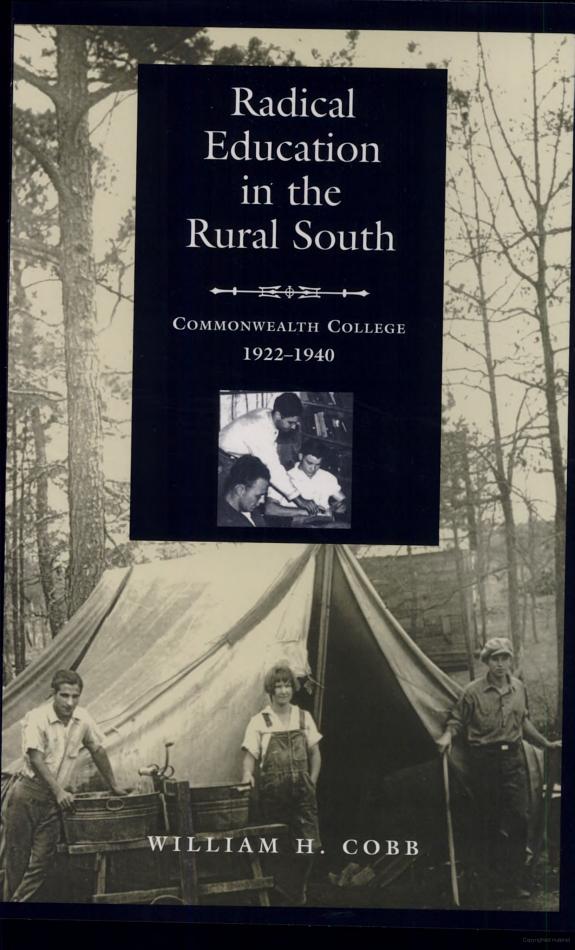
Radical Education in the Rural South

Radical Education in the Rural South

Commonwealth College, 1922-1940

by William H. Cobb

263 pages· 2000· ISBN 9780814327739
About
Commonwealth College was the longest-lived and most notorious of the resident labor colleges that operated during the 1920s and 1930s. Founded in 1923 at NewLlano Cooperative Colony in Vernon Parish, Louisiana, the school was modeled on the self-maintenance characteristics of Florida's abortive prewar experiment in social education: Ruskin College. Disputes over priorities with NewLlano Colony forced the College to relocate to rural Polk County, Arkansas, in 1924 where it took up permanent residence in the dense "piney woods" at the foot of Rich Mountain. Commonwealth's early leaders were dedicated Debsian Socialists who were convinced that a different type of education for the new industrial class would result in a series of massive social changes that would transform American capitalism into thc utopian cooperative commonwealth of their dreams. The regional and national publicity that resulted from the allegations that the College was a Moscow-driven "red cell' became a self-fulfilling prophecy from the mid- to late 1930s. Commonwealth endured spectacular attacks by the American Legion in 1926, from a Communist "student strike" in 1933, from investigations by the Arkansas General Assembly in 1935 and 1937, and through its association with the Southern Tenant Farmer's Union. By 1938 the school had exhausted the patience of the people it had been founded to educate -- the industrial workers. Finally, without any friends in the non-Communist left, Commonwealth attempted to become the southern campus of the New Theatre League, but strident local opposition brought a court action that forced the College to close in September 1940. William H. Cobb illuminates the history of theextraordinary group of students and staff of Commonwealth College and the rich intellectual life produced on the self-sustaining communal farm in the Arkansas forest. Although Cobb did not have access to Commonwealth College papers, which disappeared after being impounded by the county court, he reconstructs the history of the school through a rich assortment of primary documents from various university and state archives. Scholars and students interested in union, labor, and southern history will welcome this book.

Discuss Radical Education in the Rural South with other readers

Join or start a book club for Radical Education in the Rural South on Readfeed. Live chat, shared reading progress, and AI discussion questions — free to get started.

Frequently asked questions

How do I join a book club for Radical Education in the Rural South?

Sign up free on Readfeed, then browse public clubs or start your own club with Radical Education in the Rural South as the current read. Invite friends with a share link and discuss together with live chat and AI discussion questions.

Can I discuss Radical Education in the Rural South with other readers online?

Yes. Readfeed book clubs let you chat live, share progress, and join discussions about Radical Education in the Rural South with readers worldwide — whether your club is virtual, in-person, or hybrid.

Is Readfeed free?

Yes. Creating an account and joining book clubs is free. Sign up to find readers who love the same books and start discussing today.