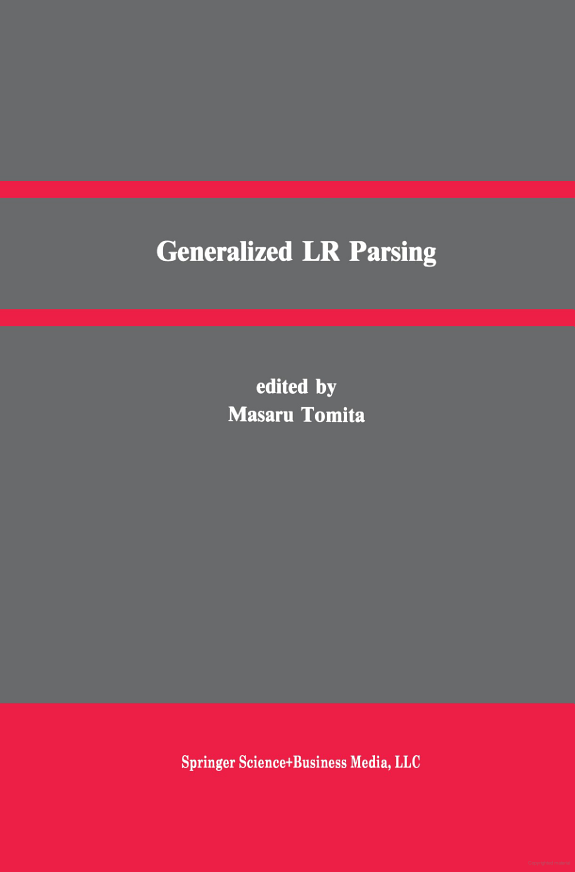
Generalized LR Parsing
by Masaru Tomita
166 pages· 2012· ISBN 9781461540342
About
The Generalized LR parsing algorithm (some call it "Tomita's algorithm") was originally developed in 1985 as a part of my Ph.D thesis at Carnegie Mellon University. When I was a graduate student at CMU, I tried to build a couple of natural language systems based on existing parsing methods. Their parsing speed, however, always bothered me. I sometimes wondered whether it was ever possible to build a natural language parser that could parse reasonably long sentences in a reasonable time without help from large mainframe machines. At the same time, I was always amazed by the speed of programming language compilers, because they can parse very long sentences (i.e., programs) very quickly even on workstations. There are two reasons. First, programming languages are considerably simpler than natural languages. And secondly, they have very efficient parsing methods, most notably LR. The LR parsing algorithm first precompiles a grammar into an LR parsing table, and at the actual parsing time, it performs shift-reduce parsing guided deterministically by the parsing table. So, the key to the LR efficiency is the grammar precompilation; something that had never been tried for natural languages in 1985. Of course, there was a good reason why LR had never been applied for natural languages; it was simply impossible. If your context-free grammar is sufficiently more complex than programming languages, its LR parsing table will have multiple actions, and deterministic parsing will be no longer possible.
Discuss Generalized LR Parsing with other readers
Join or start a book club for Generalized LR Parsing on Readfeed. Live chat, shared reading progress, and AI discussion questions — free to get started.
Frequently asked questions
How do I join a book club for Generalized LR Parsing?
Sign up free on Readfeed, then browse public clubs or start your own club with Generalized LR Parsing as the current read. Invite friends with a share link and discuss together with live chat and AI discussion questions.
Can I discuss Generalized LR Parsing with other readers online?
Yes. Readfeed book clubs let you chat live, share progress, and join discussions about Generalized LR Parsing with readers worldwide — whether your club is virtual, in-person, or hybrid.
Is Readfeed free?
Yes. Creating an account and joining book clubs is free. Sign up to find readers who love the same books and start discussing today.