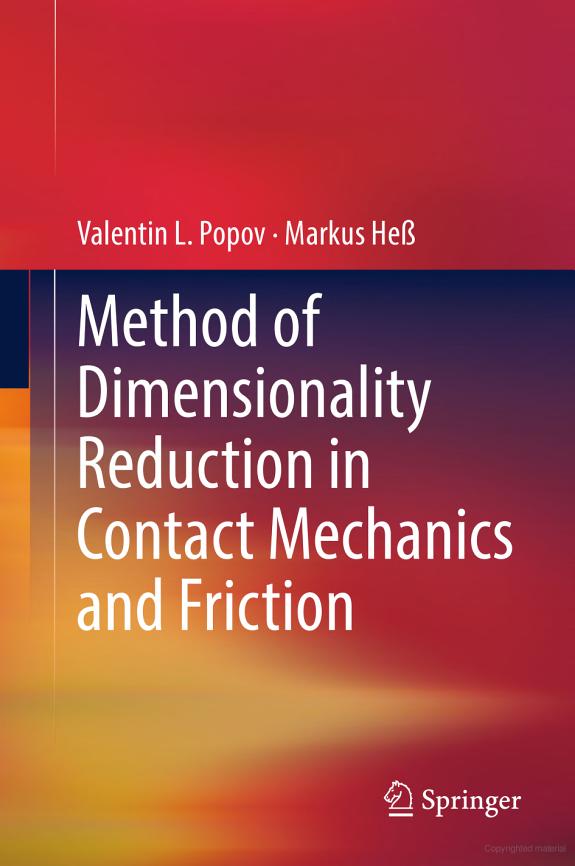
Method of Dimensionality Reduction in Contact Mechanics and Friction

Method of Dimensionality Reduction in Contact Mechanics and Friction

by Valentin Popov, Markus Heß

265 pages· 2014· ISBN 9783642538766
About
This book describes for the first time a simulation method for the fast calculation of contact properties and friction between rough surfaces in a complete form. In contrast to existing simulation methods, the method of dimensionality reduction (MDR) is based on the exact mapping of various types of three-dimensional contact problems onto contacts of one-dimensional foundations. Within the confines of MDR, not only are three dimensional systems reduced to one-dimensional, but also the resulting degrees of freedom are independent from another. Therefore, MDR results in an enormous reduction of the development time for the numerical implementation of contact problems as well as the direct computation time and can ultimately assume a similar role in tribology as FEM has in structure mechanics or CFD methods, in hydrodynamics. Furthermore, it substantially simplifies analytical calculation and presents a sort of “pocket book edition” of the entirety contact mechanics. Measurements of the rheology of bodies in contact as well as their surface topography and adhesive properties are the inputs of the calculations. In particular, it is possible to capture the entire dynamics of a system – beginning with the macroscopic, dynamic contact calculation all the way down to the influence of roughness – in a single numerical simulation model. Accordingly, MDR allows for the unification of the methods of solving contact problems on different scales. The goals of this book are on the one hand, to prove the applicability and reliability of the method and on the other hand, to explain its extremely simple application to those interested.

Discuss Method of Dimensionality Reduction in Contact Mechanics and Friction with other readers

Join or start a book club for Method of Dimensionality Reduction in Contact Mechanics and Friction on Readfeed. Live chat, shared reading progress, and AI discussion questions — free to get started.

Frequently asked questions

How do I join a book club for Method of Dimensionality Reduction in Contact Mechanics and Friction?

Sign up free on Readfeed, then browse public clubs or start your own club with Method of Dimensionality Reduction in Contact Mechanics and Friction as the current read. Invite friends with a share link and discuss together with live chat and AI discussion questions.

Can I discuss Method of Dimensionality Reduction in Contact Mechanics and Friction with other readers online?

Yes. Readfeed book clubs let you chat live, share progress, and join discussions about Method of Dimensionality Reduction in Contact Mechanics and Friction with readers worldwide — whether your club is virtual, in-person, or hybrid.

Is Readfeed free?

Yes. Creating an account and joining book clubs is free. Sign up to find readers who love the same books and start discussing today.