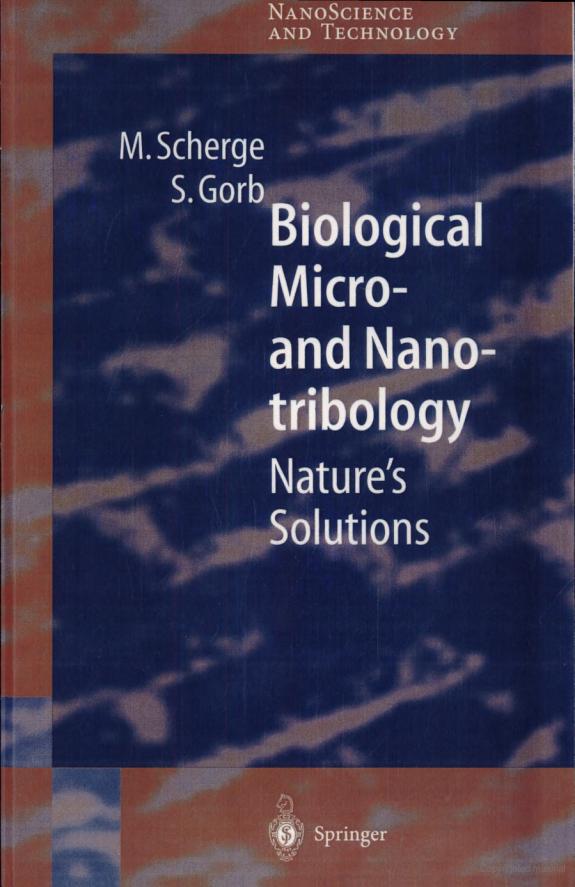
Biological Micro- and Nanotribology

Biological Micro- and Nanotribology

by Stanislav N. Gorb, Matthias Scherge, Stanislav Gorb

304 pages· 2001· ISBN 9783540411888
About
Ever since the genesis of life, and throughout the course its further evolution, Nature has constantly been called upon to act as an engineer in solving technical problems. Organisms have evolved a variety of well-defined shapes and structures. Although often intricate and fragile, they can nonetheless deal with extreme mechanical loads. Some organisms live attached to a substrate; others can also move, fly, swim and dive. These abilities and many more are based on a variety of ingenious structural solutions. Understanding these is of major scientific interest, since it can give insights into the workings of Nature in evolutionary processes. Beyond that, we can discover the detailed chemical and physical properties of the materials which have evolved, can learn about their use as structural elements and their biological role and function. This knowledge is also highly relevant for technical applications by humans. Many of the greatest challenges for today's engineering science involve miniaturization. Insects and other small living creatures have solved many of the same problems during their evolution. Zoologists and morphologists have collected an immense amount of information about the structure of such living micromechanical systems. We have now reached a sophistication beyond the pure descriptive level. Today, advances in physics and chemistry enable us to measure the adhesion, friction, stress and wear of biological structures on the micro- and nanonewton scale. Furthermore, the chemical composition and properties of natural adhesives and lubricants are accessible to chemical analysis.

Discuss Biological Micro- and Nanotribology with other readers

Join or start a book club for Biological Micro- and Nanotribology on Readfeed. Live chat, shared reading progress, and AI discussion questions — free to get started.

Frequently asked questions

How do I join a book club for Biological Micro- and Nanotribology?

Sign up free on Readfeed, then browse public clubs or start your own club with Biological Micro- and Nanotribology as the current read. Invite friends with a share link and discuss together with live chat and AI discussion questions.

Can I discuss Biological Micro- and Nanotribology with other readers online?

Yes. Readfeed book clubs let you chat live, share progress, and join discussions about Biological Micro- and Nanotribology with readers worldwide — whether your club is virtual, in-person, or hybrid.

Is Readfeed free?

Yes. Creating an account and joining book clubs is free. Sign up to find readers who love the same books and start discussing today.