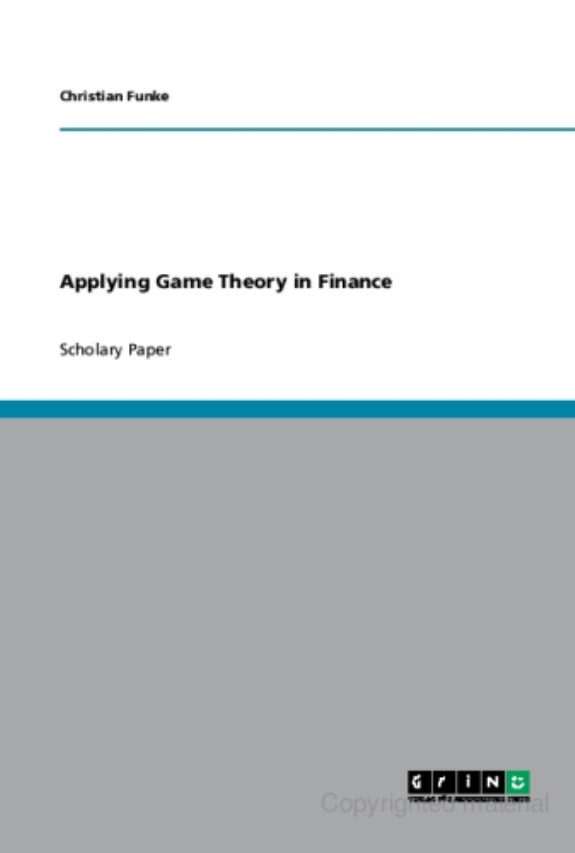
Applying Game Theory in Finance
by Christian Funke
64 pages· 2007· ISBN 9783638646123
About
Seminar paper from the year 2003 in the subject Business economics - Investment and Finance, printed single-sided, grade: 1,0 (A), European Business School - International University Schloss Reichartshausen Oestrich-Winkel (Department for Corporate Finance and Capital Markets), course: Seminar International Corporate Finance, 50 entries in the bibliography, language: English, abstract: The groundbreaking work of MODIGLIANI & MILLER (MM) introduced the rigors of economic analysis to financial research. This is generally considered the beginning point of modern managerial finance. Their first economic models were challenged by financial practitioners for being overly simplistic in their assumptions and, therefore, lacking real world application value. MM acknowledged and addressed this fact in their first paper. Later models relaxed some assumptions, such as symmetric information or complete contracts, while trying to retain an explanatory value in the spirit of the original MM papers. This incorporation of more realistic elements, such as strategic interaction and asymmetric information, brought several problems to financial economists' models: they required a lot of definitions, became even more complex and were not easily comparable. Game theory provided a solution for those problems in its first applications to economics in the 70s and 80s: a set of common definitions and a basic language to guarantee comparability and empirical testability of financial models using game theoretic concepts. Nowadays, there are few issues in finance research which have not been modeled by applying game theoretic concepts, and therefore it is crucial to be familiar with the basics of game theory and its application in finance. The objective of this paper is to provide an intuitive approach to game theory in finance by first giving an overview of the basic foundations of game theory, and then providing a survey of some selected applications most relevant to the financial practitioner."
Discuss Applying Game Theory in Finance with other readers
Join or start a book club for Applying Game Theory in Finance on Readfeed. Live chat, shared reading progress, and AI discussion questions — free to get started.
Frequently asked questions
How do I join a book club for Applying Game Theory in Finance?
Sign up free on Readfeed, then browse public clubs or start your own club with Applying Game Theory in Finance as the current read. Invite friends with a share link and discuss together with live chat and AI discussion questions.
Can I discuss Applying Game Theory in Finance with other readers online?
Yes. Readfeed book clubs let you chat live, share progress, and join discussions about Applying Game Theory in Finance with readers worldwide — whether your club is virtual, in-person, or hybrid.
Is Readfeed free?
Yes. Creating an account and joining book clubs is free. Sign up to find readers who love the same books and start discussing today.