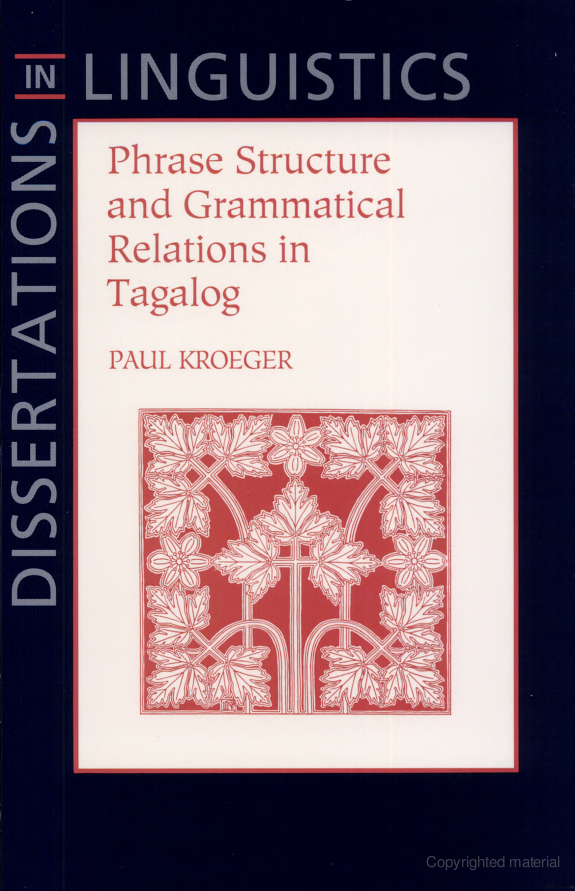
Phrase Structure and Grammatical Relations in Tagalog

Phrase Structure and Grammatical Relations in Tagalog

by Paul Kroeger

240 pages· 1993· ISBN 9780937073865
About
Over the last twenty years or so, most of the work on the syntax of Philippine languages has been focused on the question of whether or not these languages can be said to have grammatical subjects, and if so which argument of a basic transitive clause should be analysed as being the subject. Paul Kroeger's contribution to this debate asserts that grammatical relations such as subject and object are syntactic notions, and must be identified on the basis of syntactic properties, rather than by semantic roles or discourse functions. A large number of syntactic processes in Tagalog uniquely select the argument which bears the nominative case. On the other hand, the data which have been used in the debate to assert the ambiguity of subjecthood are best analysed in terms of semantic rather than syntactic constraints. Together these facts support an analysis that takes the nominative argument as the subject. Kroeger examines the history of the subjecthood debate and uses data from Tagalog to test the theories that have been put forth. His conclusions entail consequences for certain linguistic concepts and theories, and lead Kroeger to assert that grammatical relations are not defined in terms of surface phrase structure configurations, contrary to the assumptions of many approaches to syntax including the Government-Binding theory. Paul Kroeger is presently doing fieldwork in Austronesian languages and teaching linguistics to fieldworkers from around the world.

Discuss Phrase Structure and Grammatical Relations in Tagalog with other readers

Join or start a book club for Phrase Structure and Grammatical Relations in Tagalog on Readfeed. Live chat, shared reading progress, and AI discussion questions — free to get started.

Frequently asked questions

How do I join a book club for Phrase Structure and Grammatical Relations in Tagalog?

Sign up free on Readfeed, then browse public clubs or start your own club with Phrase Structure and Grammatical Relations in Tagalog as the current read. Invite friends with a share link and discuss together with live chat and AI discussion questions.

Can I discuss Phrase Structure and Grammatical Relations in Tagalog with other readers online?

Yes. Readfeed book clubs let you chat live, share progress, and join discussions about Phrase Structure and Grammatical Relations in Tagalog with readers worldwide — whether your club is virtual, in-person, or hybrid.

Is Readfeed free?

Yes. Creating an account and joining book clubs is free. Sign up to find readers who love the same books and start discussing today.