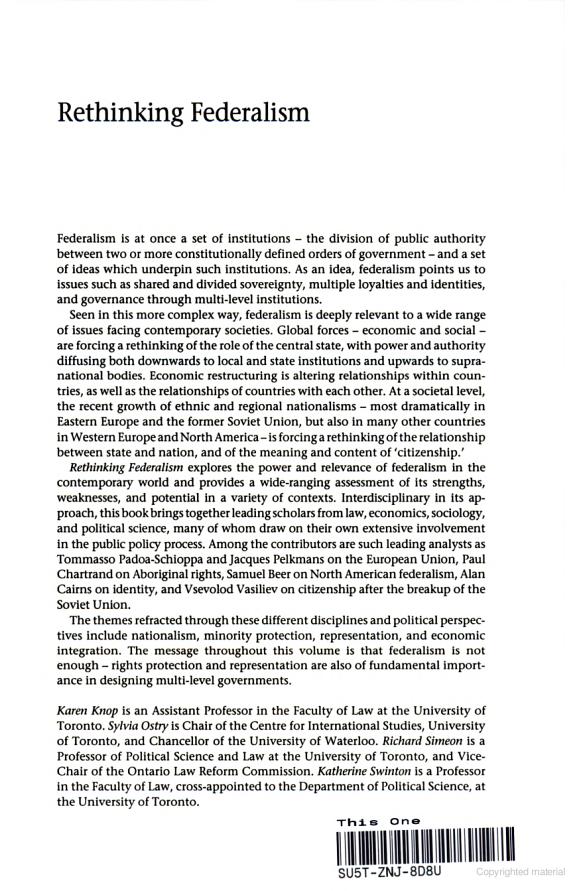
!DOCTYPE html PUBLIC "-//IETF//DTD HTML 2.0//EN" meta name="generator" content="HTML Tidy, see www.w3.org" Federalism is at once a set of institutions -- the division of public authority between two or more constitutionally defined orders of government -- and a set of ideas which underpin such institutions. As an idea, federalism points us to issues such as shared and divided sovereignty, multiple loyalties and identities, and governance through multi-level institutions. Seen in this more complex way, federalism is deeply relevant to a wide range of issues facing contemporary societies. Global forces -- economic and social -- are forcing a rethinking of the role of the central state, with power and authority diffusing both downwards to local and state institutions and upwards to supranational bodies. Economic restructuring is altering relationships within countries, as well as the relationships of countries with each other. At a societal level, the recent growth of ethnic and regional nationalisms -- most dramatically in Eastern Europe and the former Soviet Union, but also in many other countries in western Europe and North America -- is forcing a rethinking of the relationship between state and nation, and of the meaning and content of 'citizenship.' Rethinking Federalism explores the power and relevance of federalism in the contemporary world, and provides a wide-ranging assessment of its strengths, weaknesses, and potential in a variety of contexts. Interdisciplinary in its approach, it brings together leading scholars from law, economics, sociology, and political science, many of whom draw on their own extensive involvement in the public policy process. Among the contributors, each writing with the authority of experience, are Tommaso Padoa-Schioppa and Jacques Pelkmans on the European Union, Paul Chartrand on Aboriginal rights, Samuel Beer on North American federalism, Alan Cairns on identity, and Vsevolod Vasiliev on citizenship after the breakup of the Soviet Union. The themes refracted through these different disciplines and political perspectives include nationalism, minority protection, representation, and economic integration. The message throughout this volume is that federalism is not enough -- rights protection and representation are also of fundamental importance in designing multi-level governments.