Thought Suppression: Divergent Implications for Explicit and Implicit Memory

Thought Suppression: Divergent Implications for Explicit and Implicit Memory

90 pages· 2007· ISBN 9780549551522
About
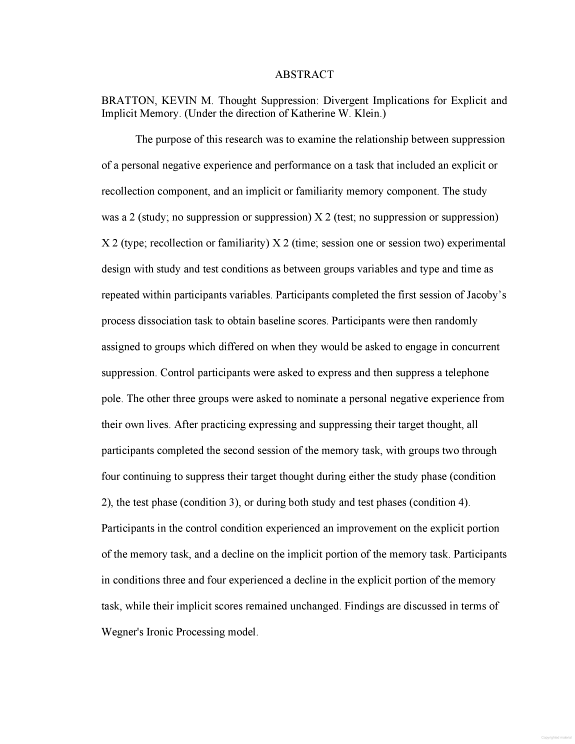
The purpose of this research was to examine the relationship between suppression of a personal negative experience and performance on a task that included an explicit or recollection component, and an implicit or familiarity memory component. The study was a 2 (study; no suppression or suppression) X 2 (test; no suppression or suppression) X 2 (type; recollection or familiarity) X 2 (time; session one or session two) experimental design with study and test conditions as between groups variables and type and time as repeated within participants variables. Participants completed the first session of Jacoby's process dissociation task to obtain baseline scores. Participants were then randomly assigned to groups which differed on when they would be asked to engage in concurrent suppression. Control participants were asked to express and then suppress a telephone pole. The other three groups were asked to nominate a personal negative experience from their own lives. After practicing expressing and suppressing their target thought, all participants completed the second session of the memory task, with groups two through four continuing to suppress their target thought during either the study phase (condition 2), the test phase (condition 3), or during both study and test phases (condition 4). Participants in the control condition experienced an improvement on the explicit portion of the memory task, and a decline on the implicit portion of the memory task. Participants in conditions three and four experienced a decline in the explicit portion of the memory task, while their implicit scores remained unchanged. Findings are discussed in terms of Wegner's Ironic Processing model.

Discuss Thought Suppression: Divergent Implications for Explicit and Implicit Memory with other readers

Join or start a book club for Thought Suppression: Divergent Implications for Explicit and Implicit Memory on Readfeed. Live chat, shared reading progress, and AI discussion questions — free to get started.

Frequently asked questions

How do I join a book club for Thought Suppression: Divergent Implications for Explicit and Implicit Memory?

Sign up free on Readfeed, then browse public clubs or start your own club with Thought Suppression: Divergent Implications for Explicit and Implicit Memory as the current read. Invite friends with a share link and discuss together with live chat and AI discussion questions.

Can I discuss Thought Suppression: Divergent Implications for Explicit and Implicit Memory with other readers online?

Yes. Readfeed book clubs let you chat live, share progress, and join discussions about Thought Suppression: Divergent Implications for Explicit and Implicit Memory with readers worldwide — whether your club is virtual, in-person, or hybrid.

Is Readfeed free?

Yes. Creating an account and joining book clubs is free. Sign up to find readers who love the same books and start discussing today.