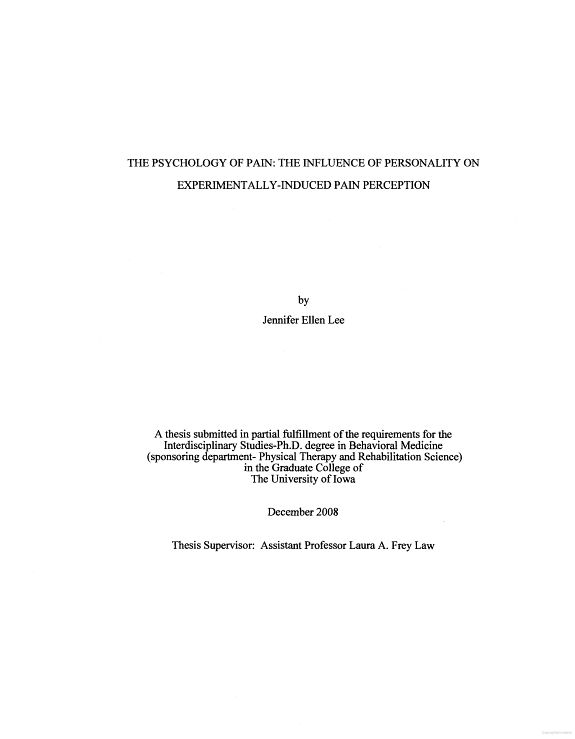
The Psychology of Pain: The Influence of Personality on Experimentally-induced Pain Perception

The Psychology of Pain: The Influence of Personality on Experimentally-induced Pain Perception

176 pages· 2008· ISBN 9781109023787
About
Pain is a debilitating condition affecting millions of Americans each year. However, relatively little is known about why certain individuals develop painful conditions, yet others remain insensitive to pain. Research suggests that certain psychological factors, including personality, may influence pain perception. However, few known studies have directly examined multiple psychological constructs simultaneously in non-patient groups. The purpose of these studies was to examine the association between higher-order personality traits (neuroticism, extraversion), lower-order psychological constructs (fear of pain, pain catastrophizing---situational and dispositional, somatosensory amplification), and pain perception in healthy individuals using two experimental pain models. Participants completed baseline psychological measures and participated in either an intramuscular infusion task producing deep muscle soreness (N = 87) or a cold pressor task immersing the hand (N = 66). In the muscle pain experiment, all of the lower-order personality constructs (somatosensory amplification, pain catastrophizing, fear of pain) were associated with pain ratings, but neither of the higher-order constructs (neuroticism, extraversion) were related to pain perception. In the cold pressor pain experiment, situational pain catastrophizing was related to all pain measures, whereas neuroticism, somatosensory amplification, fear of pain, and dispositional pain catastrophizing were related to qualitative measures of pain, but not pain intensity ratings. A third study investigated the strength of the associations between the higher- and lower-order personality characteristics measured in Experiments 1 and 2. Neuroticism was positively correlated with somatosensory amplification, fear of pain, dispositional and situational pain catastrophizing, and negatively correlated with extraversion. Extraversion was not related to any of the lower-order constructs. All of the lower-order constructs were significantly positively correlated, but the association between somatosensory amplification and situational pain catastrophizing was no longer significant after controlling for neuroticism. These results suggest both higher- and lower-order psychological variables may be associated with pain perception across two experimental pain conditions. However, the lower-order constructs were generally more strongly related to qualitative and quantitative pain measures than the higher-order personality indices. This information may provide may be useful for the development and advancement of pain assessments and treatments while considering the multidimensional nature of pain.

Discuss The Psychology of Pain: The Influence of Personality on Experimentally-induced Pain Perception with other readers

Join or start a book club for The Psychology of Pain: The Influence of Personality on Experimentally-induced Pain Perception on Readfeed. Live chat, shared reading progress, and AI discussion questions — free to get started.

Frequently asked questions

How do I join a book club for The Psychology of Pain: The Influence of Personality on Experimentally-induced Pain Perception?

Sign up free on Readfeed, then browse public clubs or start your own club with The Psychology of Pain: The Influence of Personality on Experimentally-induced Pain Perception as the current read. Invite friends with a share link and discuss together with live chat and AI discussion questions.

Can I discuss The Psychology of Pain: The Influence of Personality on Experimentally-induced Pain Perception with other readers online?

Yes. Readfeed book clubs let you chat live, share progress, and join discussions about The Psychology of Pain: The Influence of Personality on Experimentally-induced Pain Perception with readers worldwide — whether your club is virtual, in-person, or hybrid.

Is Readfeed free?

Yes. Creating an account and joining book clubs is free. Sign up to find readers who love the same books and start discussing today.